


By Gautaman Bhaskaran
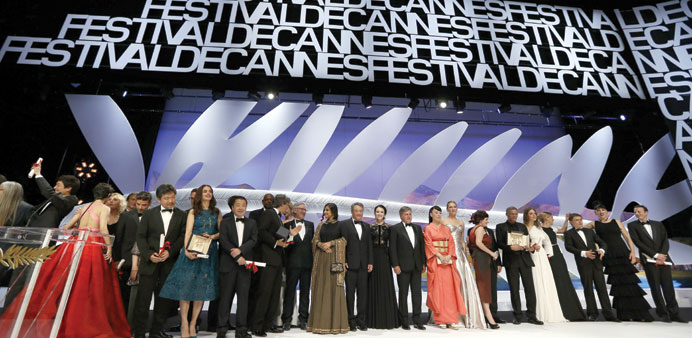
The Cannes Film Festival, which ended its 66th edition on May 26, had India as its country of focus. To celebrate 100 years of Indian cinema, that is. But the nation of a billion plus people and an annual movie production of 1,200 or so failed to live up to the occasion.
To begin with, the three of four Indian films which were chosen by the Festival and its sidebars to showcase India were disappointing. If the anthological Bombay Talkies meant as a Cannes’ official tribute to Indian cinema merely represented the Hindi language (one of the many Indian languages in which movies are made in the country), three of the four stories in the work, helmed by different directors, were really not up to the mark.
Dibakar Banerjee’s segment based on a Satyajit Ray narrative was by far the best, and it dealt with cinema. Anurag Kashyap’s was the worst of the lot, and had little to do with the medium itself and more with stardom. Ditto, Karan Johar’s and Zoya Akhtar’s pieces.
Also part of Cannes’ official sections, Amit Kumar’s Monsoon Shootout, set in the badlands of Mumbai and talking about an honest cop as well as his many dilemmas, turned out to be a typical masala film. I thought that it was absolute rubbish, a kind of cinema we see every day in India — loud, over-communicative, unbelievable and inauthentic — one which insults intelligence.
Yet, Peter Bradshaw, The Guardian’s movie critic wrote: “It’s an entertaining popcorn film with a twist, for which commercial success is on the cards. There should be space for pictures like it in Cannes.” Bradshaw’s tip may well be a sure formula for Cannes’ doom. And, his observation amply demonstrates how little a Westerner understands Indian cinema. Often, he tends to get swayed by the colours and sounds of the Indian screen, losing his focus in the bargain.
Kashyap’s Ugly in the Directors Fortnight — a Festival sidebar — was just that, ugly. About a divorced couple whose daughter is kidnapped, the film is a senseless piece of work by a helmer who gave the brilliant Black Friday many years ago. Kashyap’s fall has been rapid, and his Gangs of Wasseypur told in two parts and screened last year in the same section, was, despite all the hullaballoo, passé.
But Kashyap remains a Cannes favourite. All the four movies at this year’s Festival had a Kashyap connection. He directed two, and co-produced the rest.
The fourth film, Ritesh Mitra’s The Lunchbox, came as a salvation. Wonderfully scripted and acted out (by Irrfan Khan and Nawazuddin Siddique), it was a sweet tale of romance where the innocuous “Dhaba” (The Lunchbox) played Cupid to two lonely people. More about this movie in a separate column.
The question is, did Cannes walk into this kind of largely bad Indian selection with its eyes open? Or, was it pushed into the trap by Indian PR agents, more interested in selling Bollywood or Hindi cinema than meaningful pictures made in other languages?
Lousy cinema notwithstanding, India stood shamed elsewhere too, though the Festival had nothing to do here. Shocking as it may seem, Shankar Mohan, the Director of the International Film Festival of India (IFFI), the country’s arguably biggest movie event held every November at Panaji in Goa, was not seen at the Cannes Film Festival, the world’s most important movie festival.
This absence appeared particularly glaring, for Cannes offers one of the richest film packages in the world, and like Casablanca’s Rick’s Café, “where everybody goes”, the Croisette on the French Riviera is also where any movie festival worth its salt sends its director.
Why, the Mumbai Film Festival’s Director, S Narayanan (who was at Cannes for the 25th year) was also at Cannes, and so too two of his deputies. So, while Mumbai had a three-member team scouting for movies, establishing contacts with foreign producers and helmers, IFFI appeared to care less.
Not just Mumbai, the director of just about every film festival across the globe was there at Cannes. Even, the director of the humble Chennai Film Festival, and he was there with his huge team to select cinema for his December event.
Part of India’s Union Information and Broadcasting Ministry, IFFI has been floundering for years now, largely because the government has given it precious little support. For years, it had no permanent director, and now when one has been appointed, he is hardly ever allowed to function the way he ought to.
What was equally upsetting than the absence of the IFFI Director was the totally unnecessary presence of three Indian bureaucrats at Cannes: the Secretary of the Information and Broadcasting Ministry, due to retire in June (and who is perhaps, going by the rule book, not supposed to be travelling abroad now), the Joint Secretary (Films) and the Director of Films.
These bureaucrats, who are by no stretch of imagination experts on cinema, were at Cannes at the tax-payers’ expense, and were seen at the India Pavillion. Pray, why did the government send these officials to Cannes? As one Cannes regular from India quipped, “they are here to shop and have a great all-expense paid vacation.” Indeed, it seemed so.
At a time, when the Prime Minister Manmohan Singh government is under a heavy cloud, trying to weather one scam storm after another, we had three officials from the Information and Broadcasting Ministry at Cannes, who really had no business to be here. I am told Rs 5 crores were spent on the India Pavillion and on these jet-setting babus from India. And what did they do?
The bureaucrats presided over a pavillion which to me appeared like Job Charnock’s Mid-Day Halt – a place where passersby stopped for a drink (it was wine and snacks after five in the evening), some rest and a peek at the Internet! Was any worthwhile business conducted at all at the Pavillion?
Moving beyond these men of the Ministry, I found another shocking aspect. With 4,500 accredited journalists and with Cannes being the third largest media event after the Olympics and the World Cup football, it may not be easy for the Festival to manage the crowd. Even then, some things need to be addressed.
There is something that I have been noticing for a long time, at least in reference to India. There are some Indians who are journalists, and yet are accredited with a Press badge. And that too a good one – which in the Cannes parlance would mean, one that is White or Pink with a Yellow Dot.
Now Cannes follows a rigid “caste” system as far as the Press badges go. The White is the Festival’s “Brahmin”, followed by the Pink with a Yellow Dot, which can be synonymous with “Kshatriya”. There is then the Plain Yellow, followed by Blue, Yellow and so on – representing the lower castes, even the untouchable.
I know that a leading Indian television film critic this year had only a Pink badge. The Yellow Dot was missing, which meant that he could not easily get into Press conferences, sometimes not at all. Even for the movies, he had to queue up for a longer period. There was also this young Indian woman from a Hindi daily newspaper with a blue badge, who felt frustrated throughout the Festival, for she found access very difficult.
On the contrary, there were others from India — festival directors, casting agents and PR persons — who were sporting the Pink with the Yellow Dot Press badges, and walking in and out of screenings and conferences with little effort.
Now, these men and women would perhaps write a few articles in a whole year, and certainly cannot pass off as journalists. Last year, Cannes invited with full local hotel and hospitality a former director of IFFI, and she came as a journalist!
Cannes seems to be goofing up on its Indian guests.
(Gautaman Bhaskaran has covered
the Cannes Film Festival for 23 years,
and may be e-mailed at