


Deputy News Editor
 |
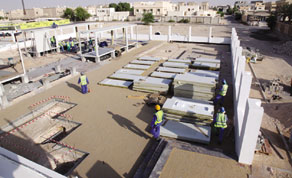
| Panels being assembled on the site for the prototype construction |
The migrant worker housing project, conceived by a team from Virginia Commonwealth University in Qatar (VCUQatar), is being promoted as a holistic and sustainable model.
“It can sustain businesses including support services, housekeeping, and catering and be profitable while improving workers’ lives,” said Roman Turczyn, director, Center for Research, Design and Entrepreneurship at VCUQatar.
The prototype of the project, supported by Qatar Foundation chairperson HH Sheikha Moza bint Nasser and financed by Qatar Science & Technology Park, is fast nearing completion in Education City.
Students, alumni, faculty, and architects are among those involved in the project, which originated from a group of students at the Tasmeem 2007 International Design Conference at VCUQatar.
Peter Chomowicz, associate dean (research and development), VCUQatar, pointed out that there are 16mn migrant workers in just the GCC countries alone, and 300mn worldwide.
“Qatar can make a huge impact. This has to be a partnership with the government, ministries, education, research, contractors – it is a very complicated problem as well as a major policy conversation,” he said.
Referring to the prevailing situation in Qatar with regard to workers’ accommodation, Turczyn observed that demand is outstripping supply.
“Workers are packed into whatever is available. But that will change, Qatar is already addressing the issue, they are looking at it, the laws will change, they will set a benchmark for standard.
“Once that standard is set the current accommodations which does not make the cut will not be permitted to exist. And then the next solution could be ours, we hope. Compared to Portacabins, our modules can last 15 to 20 years easily and are superior on any count,” he said.
At the core of the VCUQatar concept for migrant worker housing is the idea of portability, Chomowicz explained.
“Imagine workers being transported from Industrial Area to Al Shamal to build a stadium. It is a two-hour drive, one way. How is that quality of life, four hours on the bus on top of the already really hard day?
“Our housing modules could be placed near the worksites, when they are needed. Depending on the requirement, the accommodation capacity could be scaled up or down and when the work is finished, the modules could be moved to the next location.
“In fact, Qatar has said that some of the stadiums being built for the FIFA 2022 World Cup will be demounted and shipped around the world. So this is actually a similar kind of concept – that you build what you need when you need it,” he said.
Turczyn asserted that by having the funding for the pilot study it could be demonstrated that by providing better living conditions for workers and through better management, productivity will increase.
The single most important prerequisite to improve the living conditions of migrant workers are national standards for the planning, design, and operation of their accommodation with sensitivity to their cultural, social, and psychological needs.
The goal for a national standard would be to reflect on Qatar’s commitment to the four pillars of Qatar National Vision 2030 for sustainable development and to adhere to international human rights standards.
“Taking the lead in this mission will not only improve the lives of migrant workers but also place Qatar in the forefront of improving the Gulf wide image with respect to human rights,” he added.
 |
| Housing modules being placed on top of each other. Right: An exterior of the site where the prototype has been constructed. PICTURES: Roman Turczyn |