


Agencies/Baghdad
At least 75 people were killed and over 200 injured in a series of car bombings that hit Baghdad yesterday, security and medical officials said.
Car bombs exploded in 10 different districts of the Iraqi capital, hitting busy markets in areas mainly populated by Shia Muslims.
Traffic disappeared from the streets in the wake of the explosions and shops and markets pulled down their shutters, witnesses said.
Army and police deployed across the city and traffic police ordered owners to remove parked vehicles.
No group claimed responsibility for the blasts. But Sunni Muslim Islamist insurgents and Al Qaeda’s Iraqi wing have increased attacks since the beginning of the year and often target Shia districts.
Twin bombs just several hundred metres apart killed at least 13 people in the capital’s Sadr City area, police and hospital officials said.
“A driver hit another car and left pretending to bring traffic police. Another car rushed to take him away and right after his car exploded among people who had gathered to see what was happening,” said bystander Hassan Kadhim. “People were shouting for help and blood covered their faces.”
Two of the blasts, both involving vehicles rigged with explosives, went off near used car dealerships in Habibiyah, destroying dozens of cars as Iraq’s national football team were playing Liberia in a friendly at Shaab stadium a short distance away.
“Guards are here, and a car explodes here,” screamed Fadhel Hanoun, a used car dealer who lamented that not only had people died, but many had lost their savings, locked up in cars they had hoped to sell.
“How can we understand this?” he said, adding: “This is a failed state.”
Another man walked past, crying and shouting, “You must know, this was an organised operation.”
“Checkpoints, they do not actually check the cars entering here,” he said, alluding to the multiple searches vehicles had to pass through to get to the dealerships.
Baghdad has been hit by a number of bombings, often in Shia areas, so far this month, in which dozens of people have died.
Elsewhere, shootings in the disputed province of Kirkuk killed an anti-Al Qaeda militiaman and a private generator operator, while a roadside bomb in the main northern city of Mosul left a police colonel dead.
The areas of north Iraq where the attacks occurred are home to substantial populations of Sunni Arabs, the community that has for months held demonstrations against alleged government targeting and discrimination.
While the government has made some concessions aimed at placating protesters and Iraqi Sunnis in general, such as freeing prisoners and raising the salaries of Sunni anti-Al Qaeda fighters, underlying issues have yet to be addressed.
And an April 23 security forces raid on a protest site that sparked clashes in which dozens died sent tensions soaring higher still.
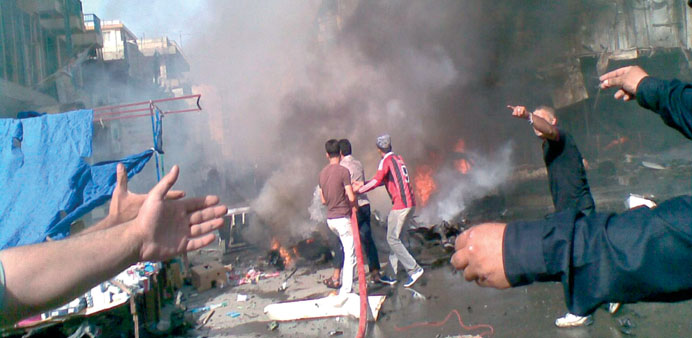
People gather at the site of a car bomb attack in Baghdad yesterday.