


Qatargas yesterday announced its support for ‘A Flower Each Spring’ programme conducted by the Friends of the Environment Centre (FEC) under the patronage of HH Sheikha Mozah bint Nasser.

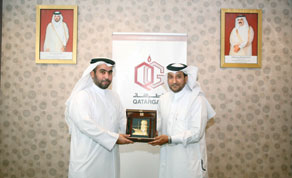
Al-Naimi and al-Sheaibi at the ceremony
During a brief ceremony held at Qatargas’ Doha head office, public relations manager Mansour Rashid al-Naimi handed over a cheque to FEC public relations manager Khalid al-Sheaibi.
Al-Naimi said responsible environmental management and high standards of environmental performance is a key element of Qatargas’ corporate social responsibility programme.
“We are keen to participate in initiatives that promote awareness and protection of the environment and contribute towards sustainable development, thereby supporting the Environmental Development Pillar of the Qatar National Vision 2030.”
Al-Sheaibi thanked Qatargas for supporting the ‘A Flower Each Spring’ programme that aims to increase community awareness on the importance of vegetation in protecting the environment from degradation and desertification.
The programme also aims to build a positive attitude towards the natural environment among young people and develop innovative capacity and creativity in the fields of environmental development, especially among children.”
The ‘A Flower Each Spring’ programme aims at introducing the flora of Qatar in their natural habitats, to the local community, in order to be protected and grown well.
This year, a plant named ‘Ananasis Setifera’ has been chosen for the programme. The FEC will organise several activities including field trips and festivals focusing on this plant.
‘Ananasis Setifera’, is an under shrub with many branches, covered with juicy leaves. The flowers are very small and appear in November and December.
The halophyte (salt tolerant) plant grows in salt marshes along the shores of the Gulf, especially in the south-west regions of Qatar. The habitat supporting the plant has saline soil, usually not immersed in sea water.
Halophytes have immense relevance for the Gulf region and scientists are investigating the features and characteristics enabling them to tolerate and/or resist high salinity.
Such research will help scientists to develop, through genetic engineering, genetically modified organisms which tolerate and resist salinity and thereby help put land with salt soil to productive use.