


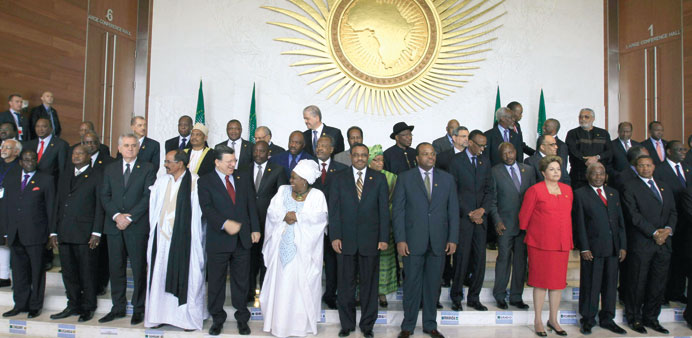
Country leaders get ready to pose for a group photograph during the 50th anniversary of the establishment of the Organisation of African Union (OAU), during the 21st Ordinary Session of the Assembly of Heads of State and Government in Ethiopia’s capital Addis Ababa.
AFP/Addis Ababa
African leaders yesterday celebrated the African Union’s 50th birthday against a backdrop of economic growth but also awareness of the armed conflicts and the other myriad problems faced by the continent.
AU Chairman and Ethiopian Prime Minister Hailemariam Desalegn set a tone of optimism when he launched extravagant celebrations by urging leaders to “create a continent free from poverty and conflict, and an Africa whose citizens enjoy a middle income status”.
But yesterday’s party in the Ethiopian capital Addis Ababa will be followed by a more sobering two-day AU summit meeting to tackle the range of crises facing the continent.
Today’s 54-member AU is the successor of the Organisation of African Unity (OAU), established in 1963 in the heady days when independence from colonial rule was sweeping the continent.
African leaders were joined by UN Secretary General Ban Ki-moon, French President Francois Hollande, Brazilian President Dilma Rousseff, US Secretary of State John Kerry and European Commission head Jose Manuel Barroso.
China’s Vice Premier Wang Yang was also reported to be in attendance.
Africa remains the world’s poorest continent and its most war-prone but development indicators there—including health, education, infant mortality, economic growth and democracy—have improved steadily in the past 50 years.
Africa is home to some of the fastest-growing economies in the world, according to the International Monetary Fund, and has attracted huge amounts of foreign investment in recent years.
Brazil announced yesterday it was cancelling $900mn worth of debt in 12 African countries—with Congo-Brazzaville the highest with $352mn written off—as part of a broader strategy to boost ties with the continent.
Hailemariam singled out Beijing for its massive wave of investment on the continent, expressing his “deepest appreciation to China for investingbns... to assist our infrastructure endeavours”.
Despite the celebration, 24 out of the 25 nations at the bottom of the UN’s human development index are in Africa, with several of those suffering from unrest or conflict.
Hollande warned of “the scourge of terrorism” faced on the continent, as he invited leaders to December summit in Paris to boost “peace and security”.
Leaders, who said the celebrations would promote pan-Africanism and help unify the often divided continent, nodded their heads as the classic reggae hit “you’re an African” by late Jamaican singer Peter Tosh boomed out in the crowded hall.
“When we therefore talk about African solutions to African problems, it is because we know that we can only permanently silence the guns if we act in solidarity and unity,” said Nkosazana Dlamini-Zuma, head of the AU Commission, the organisation’s executive arm.
But while speaking optimistically in the AU’s modern Chinese-built headquarters about “the bright future of Africa”, she also noted that “the self-reliance and economic independence that our founders spoke of remains a bit elusive and social inequalities remain.”
Drummers, dancers and musicians later performed to a packed crowd including leaders in a giant hall, telling the history of Africa through song, dance and a flashing light show.
Music legends including Congo’s Papa Wemba and Mali’s Salif Keita were due to play.
The AU has budgeted $1.27mn for the celebrations, according to official documents seen by South Africa’s Institute for Security Studies (ISS).
AU Commission deputy chief Erastus Mwencha said he did not have the exact figure but that some $3mn would be spent on the festivities and other events over the coming year.
In recent years, the AU’s role in combat—such as its mission in Somalia to battle Al-Qaeda linked Islamists—has shown it can take concrete action, even if the funding for that mission comes mainly from Western backers.
But at the same time, the splits revealed by the 2011 conflict in Libya—when AU members squabbled between those wanting to recognise rebels and those backing Moammar Gaddafi —showed its disunity and lack of global clout.
Gaddafii’s death also stripped the AU of a major source of funding. Leaders will discuss finding backers for the cash-strapped body at the summit meeting opening today.
The agenda will also likely include the ongoing crisis in Mali, which is preparing to receive a UN peacekeeping force to support French soldiers fighting Islamist rebels in the desert north since January.
Leaders are also tipped to endorse a motion to urge the International Criminal Court to refer crimes against humanity trials for Kenya’s leaders back to their country, after foreign ministers agreed a draft proposal on Friday.
Conflict in Somalia, violence in Nigeria and rebels in eastern Democratic Republic of Congo are also expected to be discussed.