


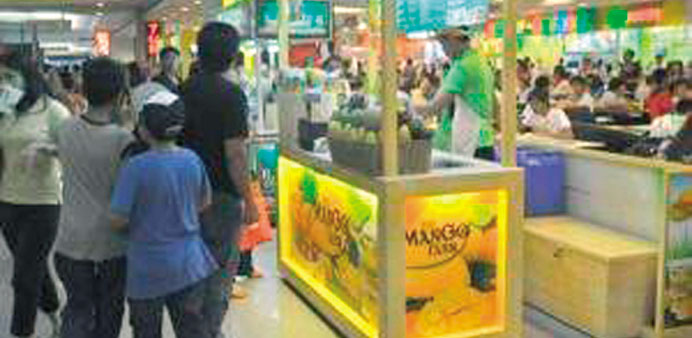
Filipinos are known to spend more on food than anything else.
Manila Times/Manila
Filipinos are fond of food.
Each province all over the country has its own specialty, and Filipinos are known to spend more on food than anything else.
Family gatherings revolve around meals, and people really go out of their way to experiment and find the best places to eat in the city.
This is why most entrepreneurs get into the food business. Even the most prominent celebrities in the country opt to open restaurants rather than selling any other kind of goods.
But for those who don’t have the capacity to open huge food chains and invest millions of pesos in upscale restaurants, opening their own food business can be close to impossible.
There’s a trend in the small-scale business industry called franchising, and it has taken off in a big way in the last few years. With so many malls rising all over the metropolis and all over the country in recent years, franchises have found an ideal outlet to make easier money than, say, a stand alone cart in a busy street corner. According to the Philippine Franchising Association (PFA), “Franchising refers to the method of practising and using another’s perfected business concept.” In other words, they offer a formula that has been proven to work.
In their website, PFA explains the concept of franchising: “In a franchise relationship, the franchisee is granted the right to market a product or a service under a marketing plan or a system that uses the trademark, name, logo and advertising owned by the franchisor.”
While not everyone has the capacity or the capital to start a business from scratch, the option to franchise is considerable since the money needed is small and the return is huge.
PFA identified numerous advantages of franchising. It has a high success rate, since this business model is based on “proven ideas and implementation.”
A recognised brand and trademark would also be beneficial for small-scale entrepreneurs, as mentioned in the PFA website. Just like name-recall in politics, franchising allows businesses to be recognised without too much marketing efforts and costs.
For the first-time businessman, franchising is also beneficial since franchisors are able to impart their operating and management efficiencies to their franchisees. Not only that, but opting to go for a franchise would make it easy for businessmen to obtain financing, and since a good franchise is an “appreciating asset,” it is easy to re-sell as well.
Huge profits can also be expected in the franchising business since lower-cost materials and supplies are utilised.
Low-cost combined with “the right marketing strategy, brand positioning and growth of the customer base, could only translate to increase in sales and immense profit,” according to PFA.
PFA identified three challenges to franchising. Control may be an issue to franchisees since they would be required to follow the system of their franchisors. Franchisees also incur on-going costs because they pay a certain percentage to their franchisor each month.
Lastly, PFA says that franchisor-franchisee relationships may hamper the success of the business, since failed expectations between two parties may arise. The five principal sectors in franchising are: fastfood; retail clothing; cafes, confectioneries and bakeshops; hospitality and wellness and food carts, PFA said. From 50 brands in the 1980s, that number has increased to over a thousand in the last three decades, with 68% of the businesses coming from homegrown concepts.
According to PFA, “Franchising contributes $6.6bn or 5% of the Philippine GDP (gross domestic product) and provides employment for 1mn Filipinos.”
That is why more business-minded Filipinos are getting into franchising, and they are visible all over the country, especially in crowded places such as malls and public transportation terminals.
The Waffle Story stall in SM City North Edsa that is owned by a Korean businesswoman earns P60,000 a month, with sales doubling during holidays. Considering that the stall opened just last April 2, the franchise already seems promising for the foreign entrepreneur.
According to Janeo Dumlao, a crew of the Waffle Story, their consumers are mostly students of University of the Philippines (UP) and their longtime customers since the waffle stall opened.
Mary Grace, which was named after the owner Mary Grace Dimacali, is also establishing its own name in the food business.
“Taste that doesn’t change from then until now,” Cathyrine Sanoria, manager of Mary Grace Kiosks at SM Mall of Asia (MOA) said when asked what makes their local and foreign customers come back.
The Kiosks store at MOA was established when the mall opened in 2006. Local mall goers such as office employees, middle class families and foreign tourists stopped to buy any of their trademark pastries.
Among all of their goods, ensaymada serves as their best-selling product because of the consistent quality and baked-fresh goodness which their competitors are not likely to have.
Filipino passion for bread is not ordinary as what we see, but average gross shows how perfectly Filipinos imbued and love breads.According to Sanoria, their average gross on weekdays ranges from P15,000 up to P20,000. While on weekends, the kiosk store generates about P20,000 to P25,000. Her initial computation shows in every piece of bread a customer would buy, 40% goes to the capital while the rest is income.
Buko Maxx’s owners Conrado Ong and John Paul Salcedo first opened it in 2011. With a P600,000 investment, a business-minded individual can open their own Buko Maxx franchise.Jay Ong opened his own franchise last October 2012 at the SM North EDSA Food Court.
Their best seller is buko or coconut shake, costing P30 for a small cup, P40 for medium cup and P60 for the large cup.
With total gross sales of P1,000 to P5,000 during weekdays and P7,000 to P8,000 during weekends, Ong’s Buko Maxx franchise is sure to live past the summer season. His total gross sales every month ranges from P100,000 to P130,000 during peak season.
“Our sales our high from December to May because there are lots of people, but sales are slow come June because it’s the beginning of classes and there are lots of expenses,” said Ferdinand Olile, a sales associate of Buko Maxx North Edsa.
Small and relatively unknown franchises—as opposed to the likes of Jollibee, Chowking, Greenwich and McDonald’s, among others—owe much of their success to the malls, which have replaced public parks as the favourite places for Filipinos to spend time.
They may not have any intention of buying anything when they visit malls, but sooner or later they will need to eat and drink.