


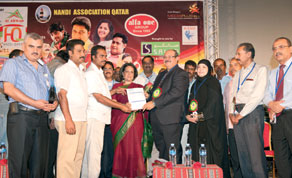
The organ donation campaign in Qatar has received a boost with the pledge by some 23 members of the Nandi Association to donate their organs after death.

Nandi members alongside Ambassador Wadhwa and Dr Fadhill show off the acknowledgment of the organ donation by will after death
Nandi Association is a Indian socio-cultural forum in Qatar.
The pledge for organ donation, which they described as a way for the Indian community to give back to their host country, was made during Nandi’s Annual Day celebration on June 15 at the Gulf Cinema.
The event was attended by more than 1,000 members of the Indian community in Qatar, and was graced by dignitaries including the Indian Ambassador to Qatar Deepa Gopalan Wadhwa, who lauded the donors and thanked them for their kind gesture.
She also lauded the organ transplantation system in Qatar which ensures that organs are given to whoever needs them, irrespective of whether they are Qataris or non-Qataris, regardless of their religion and where they come from.
“This is such a wonderful contribution of the Indian community here in Qatar as we want to give back to the country because we are able to live here and be accepted by the people here,” Ambassador Wadhwa said.
Each of the 23 donors signed an acknowledgment of an organ donation by will after death, which authorises Hamad Medical Corporation to utilise any of their body organs capable of transplantation to a living person who needs it and is expected to benefit from its transplantation.
HMC Urology and Transplant Surgery senior consultant Dr Riadh Fadhil, who received the pledges on behalf of the Corporatioon, thanked the donors and the Indian community saying:“We have learnt from our experience in life that Indian expatriates wherever they are in the world represent one of the most solid communities in these societies. We believe that this is one of the noblest causes that you are gathering to celebrate today – the donation of life. It is donation of organs after death, but it is replacing death with life. Instead of our organs turning into dust, it will be transformed into lives.”
Dr Fadhill explained that having worked in different countries in organ transplantation, Qatar has one of the most human organ transplantation and donation regulations, under which Qatari and non-Qatari, nationals and expatriates in need of organs for transplantation are given the same treatment.
“We are not only striving for the best in terms of treatment and facilities, but we are also ensuring that the organs of any deceased donor will go to the first patient on our waiting list, regardless of religion, nationality or race,” Dr Fadhil said.
“I think for the Indian community and all the expatriates in Qatar, this is the best way to give back – to donate your organs after death to save multiple lives. And by all religions, this is one of the best things that you can do in your life that will be rewarded by God,” Dr Fadhil added.