


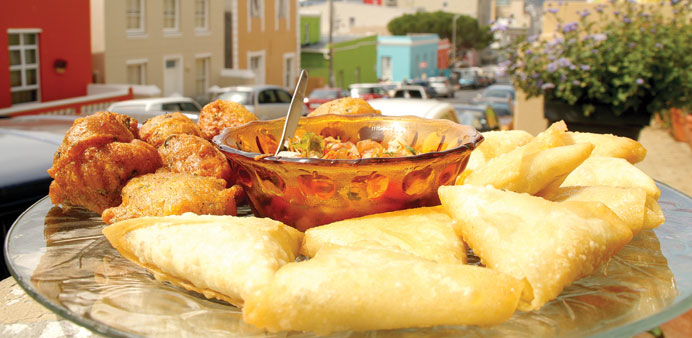
* A plate of samosas prepared by tourists during the Cape Malay Cooking Safari. In the background are brightly painted Bo-Kaap buildings.
Learning to cook from Cape Town’s Asian community. By Detlef Berg
|
|
"When I’m cooking for my family, I use two heaping tablespoons of chilli,” Faldela Tolker says, then adds with a wink of her eye, “but for you people, I’ll leave it at just one.”
She’s talking to a group of tourists visiting South Africa and taking part in a cooking safari to learn about Malayan cuisine. The setting is a small house in the Bo-Kaap district of melting-pot Cape Town.
“But don’t just stand there watching — everybody should help out,” she says bossily. “And give it your best, because whatever we cook together is going to land on the dinner table for us to eat together.”
The culinary adventure starts at the Bo-Kaap Museum at 71 Wale Street, the meeting point for the Cape Malay Cooking Safari.
“The groups are small, with a maximum of 10 participants,” says Sabelo Maku, a tour guide in Cape Town.
Today, it includes an American woman and her son, two German tourists, a family from Australia and a female reporter from a local Cape Town magazine.
To get an insight into the history of the Bo-Kaap district, a good place to start is the museum, located in one of Cape Town’s oldest buildings. “It’s furnished like a typical Muslim home of the 19th century,” Sabelo Maku points out.
Besides decor typical of the period, there are old maps and a photo exhibition. Visitors learn that Bo-Kaap is one of the oldest and most original districts of Cape Town. “It was founded in the 17th century when the Dutch East Indies Trading Company shipped in slaves to the Cape area for cheap labour,” explains Maku.
“Mostly they were people from India and Sri Lanka. But slaves were also brought here from Indonesia and Malaysia and were settled on the slopes of Signal Hill,” he said. “Most were of the Muslim faith and were called Cape Malayans. Down to this very day they have been able to preserve their cultural identity.”
During a short stroll through the narrow and steep cobblestone streets, there are mosques and minarets to be seen. The many small pastel-coloured houses dominate the scenery and for tourists with cameras, they are irresistable.
Somebody wants to know why the houses are so colourful. Sabelo smiles and says there are many stories on the subject.
“Probably somebody simply just started to paint his house a violet colour, possibly because this colour was the cheapest to be had at that moment. The neighbours didn’t want to fall behind, so they likewise applied bright colours to their houses, he says.
In order to find the spice shop “Atlas Trading,” a visitor needs only to follow his nose. The scintillating aromas stream out of the plain-looking building — scents of cinnamon and cardamon, followed by coriander and ginger.
Initially the shop was a general store, where chiefly Indian goods were sold, recalls Wahab R Ahmad, the second-generation head of the Atlas Trading Company. Only gradually did it start to concentrate completely on spices.
Inside the store there are piles of boxes and cartons, all filled to brimming with spices from around the world. Employees in blue aprons are bustling about, filling small brown paper bags with the exotic powders and exactingly weighing them.
Tour guide Sabelo covers up the signs, takes a small sample from one of the boxes and lets his group sniff and guess what it is.
“That’s right, fennel,” he says. And the coriander and saffron aren’t a problem for them. But what are turmeric and kasuri methi — also known as fenugreek — and what are they used for?
“Leaf masala is our best-seller,” says Ahmad. “It’s a mixture made from 12 spices which really are suitable for everything, be it beef, chicken or vegetables.”
Sabelo urges the group to move on, because Faldela Tolker is waiting impatiently in her kitchen. The ingredients are standing ready for the samosas, dough wraps filled with beef and spices.
“You can take care of the dough. Simply put some flour, baking powder and salt in the large bowl, blend in some butter and add a bit of water and then thoroughly knead it all together,” she instructs, while stirring curry cooking in a pot atop the stove.
Everybody takes part in rolling the dough into a paper-thin layers, and with varying degrees of competence the dough wraps are formed and filled. They have to be firmly closed before being dumped into hot oil. “Use a fork to seal the edges,” Faldela advises.
The samosas are served with falooda, a beverage made of milk, rice noodles, basil seeds and rose liquor. In the end, everyone is sitting together at the table. It’s a close encounter with South Africa — and hellishly hot and spicy. — DPA
* Faldela Tolker’s tourist guests make samosas in her Cape Town kitchen, an event during the Cape Malay Cooking Safari.
* Spices on sale in Ahmad’s spice shop, the Atlas Trading Company.