


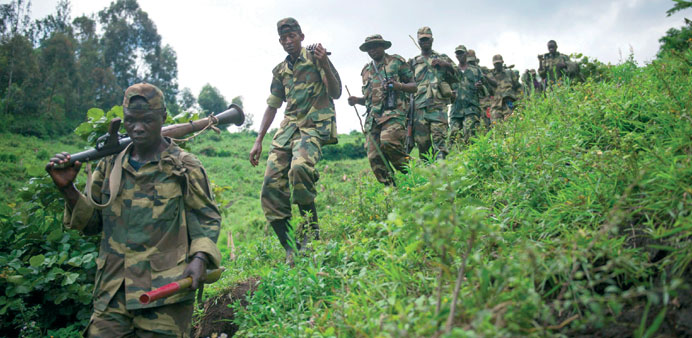
M23 rebels withdrawing through the hills after leaving their position in the village of Karuba in November 2012.
AFP/Congo
Rebels from the M23 movement and the army fought yesterday just north of Goma, a regional capital in the eastern Democratic Republic of Congo which the rebels occupied briefly last November, both sides said.
The fighting was the first involving M23 since December and erupted just two days before UN chief Ban Ki-moon was due to visit the region, including Goma, the capital of North Kivu province.
The clashes also came a week after the first troops from a new UN intervention brigade arrived in the country with a strong mandate to attack rebel groups.
An M23 spokesman, Amani Kabasha, said the unrest broke out 12km north of Goma. Colonel Olivier Hamuli, spokesman for the DRC’s armed forces, confirmed the fighting was taking place.
The Congolese army (FARDC) opened fire because of a suspected manoeuvre by M23 rebels to try to reach a road north of Goma, a Western military source said, adding that the army sustained casualties but held their position.
M23’s political chief, Bertrand Bisimwa, said the battle first started because Rwandan Hutu rebels of the Democratic Forces for the Liberation of Rwanda (FDLR) had taken an M23 position at Mutaho.
“When our troops went to fetch water, they found that the wells were already under attack by the FDLR. We chased them away,” Bisimwa said. “At 6am (0400 GMT), the FARDC (Congolese army) began shelling our positions, backed by ground troops who were shooting with light arms.” Bisimwa said the fighting had since died down, but warned that “if shooting continues, we will have to silence the guns.”
At the end of the morning a column of soldiers left the outskirts of the city, heading north, a journalist saw.
The clashes are the first to have broken out since the rebel movement, formed by army mutineers in North Kivu province last year, withdrew from Goma in December, after occupying the city of 1mn people for 10 days.
Major Vincent Tourny, an interim spokesman for MONUSCO, the UN peacekeeping mission in the DR Congo, said that the Mutaho region was attacked in the early morning by M23 rebels targeting the Congolese army.
Tourny said that sporadic shooting was followed by heavier gunfire, then mortars and rocket launchers were heard being used in the Kibati highlands, but he added that his reports had yet to be confirmed.
FARDC troops were driven back, but managed to recover their positions, and by 10am, shooting became “intermittent” in the area, Tourny said, adding that “800 civilians have fled towards Goma”.
MONUSCO put its forces on alert around Goma yesterday, he added.
UN Secretary General Ban is due to visit the DRC tomorrow as part of a tour that will take him to Goma as well as the Rwandan capital Kigali and Entebbe in Uganda.
The Kinshasa government and the UN both accuse Rwanda and Uganda of backing M23, an allegation the two neighbouring countries deny.
M23, named for a peace deal with the DRC government signed on March 23, 2009, emerged out of an ethnic Tutsi mutiny by former rebels integrated into the army, on the grounds that the Kinshasa government had failed to abide by terms of the pact.
The rebels seized Goma in November but withdrew shortly after following a promise of dialogue with Kinshasa. Since pulling out, the rebels have held positions a few kilometres from the city.
The new UN brigade will include soldiers from Tanzania, Malawi and South Africa. It has a tougher offensive mandate than MONUSCO.
The new attack force is being deployed because of persistent activity by rebels and armed militias in eastern DRC, but a Western military source said the force will not be fully operational for several weeks.
The way for the force was opened when 11 African leaders signed an agreement in February to try to bring peace to the DRC.
The pact also urged nations in the central African Great Lakes region to avoid interference in each other’s affairs. Rwanda and Uganda were signatories.
According to local radio broadcasters, hundreds of civilians were fleeing the scenes of clashes, about 10-12 kilometres north of Goma, the region’s main commercial hub.