


By Joseph Varghese/Staff Reporter
Qatar Biobank, an initiative of Qatar Foundation, will be set up on the UK Bio Bank model.
The objective is to develop a repository of biological samples from 60,000 Qatar residents “over a reasonable period of time,” officials of Imperial College London who are helping to set up Qatar Biobank, told Gulf Times.
“Imperial College is a leading designer of biobanks throughout Europe,” said Prof Paul Elliott of Epidemiology and Public Health Medicine at Imperial College London, who was in Qatar recently. He was accompanied by Prof Elio Riboli, head of the School of Public Health at Imperial College.
Imperial College, which has designed three prominent biobanks in Europe, is conducting research on data collected from different locations. Blood, saliva and urine are the biological samples collected.
“Using the collected data, we will be able to understand the characteristics that can predict the origin of many of the diseases and provide personalised medicine. Different populations have different combination of factors, hence it is important to collect more data to establish different theories,” Prof Elliott said.
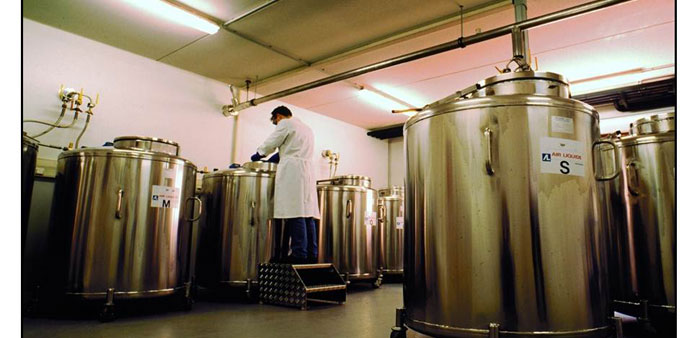
Prof Riboli said the collected samples are individually bar coded and stored in very low temperatures of -160 to -196 degrees for future research.
“A robot manages the storage of samples, which could be retrieved quickly through an automated process. We are proposing a similar plan for Qatar too,” he said.
The biological samples could be preserved for several decades.
“The first biobank was set up in 1993 and samples have been preserved for almost two decades. Almost 10 of the samples have been used for research,” Riboli said.
Elliot recalled that Imperial College London designed EPIC (Europe) with 520,000 records, the UK Bio Bank with 500,000 records and the German National Cohort with 200,000 samples. EPIC-Europe is a collaboration between 23 centres in 10 European countries. Studies in different populations allow investigation of a wide range of exposures and diseases.
Qatar Biobank, described as one-of-a-kind in the region, will be one of the largest population-based biobanks.
Regarding the method of the collection of the samples, Elliot said data is collected from healthy individuals and not patients.
“We collect data such as information about the contributing individuals, their clinical measurements and biological samples,” he added.
Qatar Biobank recently announced that it had already collected 300 records from potential contributors of biological samples. At present the biobank is operating from building 29, in Hamad Medical City.
Health information and samples are to be collected from Qatar residents who are at least 18 years’ old and nationals or expatriates who have lived in Qatar for 15 years or more.
Qatar Biobank is a centre within Qatar Foundation’s Biomedical Research Institute, in partnership with the Supreme Council of Health, Hamad Medical Corporation. It is Qatar’s first long-term and large-scale medical research initiative for the country’s population.