


The Ministry of Environment is keen to provide all favourable living conditions to marine turtles nestling on Qatari isles and coastal areas, an official has said.

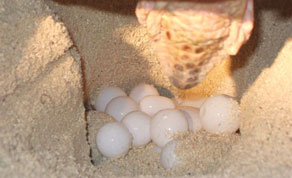
A turtle laying eggs
The nestling season of marine turtles will conclude in July.
The steps taken to protect them include tight control on the entry routes of vehicles to the Fuwairit area on the north-east coast and regular awareness campaigns targeting fishermen instructing them not to trap such animals.
The ministry has asked fishermen to free turtles in case they were caught in fishing nets, showing utmost care not to harm or injure them.
If caught, turtles should be freed immediately. “It has to be held with its head down at an angle of 45 degrees to empty its lungs of seawater.
After that, it should be allowed to slide back into sea.” Fishermen were also instructed on how to treat injured turtles and avoid killing them.
The ministry has closed down Fuwairit beach to the public and erected a fence around the entire area to further protect the turtles there, and give them more conducive conditions for mating.
Further, comprehensive studies are being conducted to identify the environmental effects on them because they are considered endangered species .
The most important areas for turtle nestling in Qatar include Fuwairit beach, Ras Laffan, Halul Island, Umm Tais and Al-Ghariyah.
These areas are also tourist spots.
The malpractices that spoil the nestling of turtles include loud sounds, strong lights, vehicles passing by their nests, stealing their eggs for food, falling into fishing nets and attacks by natural enemies such as fish, and crab.
Marine pollution has also negative effects on turtles.
Hawksbill turtles are the most common type living in the Qatari national waters.
These are also classified as endangered species by the International Union for Conservation of Nature (IUCN).
To protect such turtles, a team would relocate the nests subject to the ebb and flow of water to safer areas.
The team would measure the temperature of nests during the whole duration of the nestling process.
Further, some turtles would be fitted with satellite transmitters to track their movements all the year round and DNA samples would be taken from them for study.
Turtles do not nestle every year, their cycle of nestling usually takes place every two or three years.
Nest building and egg hatching take place at night only. During this process, female turtles are highly sensitive to light or noise.
Any noise or light can make them go back to the sea abandoning their nests.
Female turtles lay hundreds of eggs each season because very few hatchlings will survive to become adults.
In each nest, turtles lay around 70-95 eggs and they do not practice any parenting. Eggs remain in the nests for about 52-60 days to hatch unguarded by the parents in any way.