


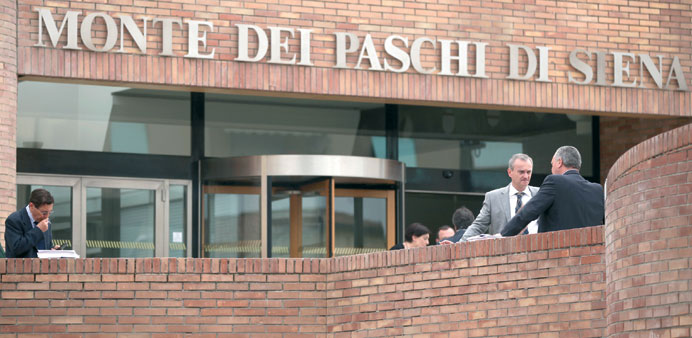
Banca Monte dei Paschi di Siena pared losses, improved asset quality and stemmed outflows in the first quarter, the first signs of the Italian bank’s recovery from a high-profile derivatives scandal.
Italy’s third-largest bank by assets reported a net loss of €100mn ($130mn) yesterday, less than analysts were expecting and a substantial reduction on the 1.6bn euro loss in the last quarter of 2012.
Monte dei Paschi, the weakest of Italy’s top five banks, took state aid earlier this year to plug a large hole in its capital base and to compensate for losses from risky derivatives trades that are now at the centre of a judicial investigation.
“We are seeing the first signs of improvement, a result of the work we carried out,” Chief Executive Fabrizio Viola said, adding he believed results would be sustainable over time.
Viola, who was called in last year together with chairman Alessandro Profumo to turn the lender around, is pushing through a restructuring to improve asset quality and cut costs.
“These numbers are a testimony of the strength and willingness of this bank to get back to what it was before these sad events,” Viola said, referring to the derivatives scandal.
The world’s oldest lender took a €60mn hit to its bottom line from interest it paid to service an expensive multibn state loan.
However, it cut net write-downs on its loan books to €484mn, almost half the previous quarter.
The bank kept its direct funding, mainly deposits from retail clients, broadly stable despite a dip in February due to the media storm that followed its revelation of previously undisclosed risky structured trades.
These trades, carried out years ago under former management, generated a loss of nearly 1bn euros in 2012.
“All in all these were good results after what it was probably their worst quarter in over 600 years,” RMJ fund manager Alessandro Frigerio.
Analysts said they had been expecting a net loss of €156mn.
Viola said Monte dei Paschi had by May made up the outflows suffered in the immediate aftermath of the derivatives affair.
The bank said its core Tier 1 ratio, a key measure of a bank’s capital strength, was 11.1% by the end of March bolstered by state loans worth about 4bn euros. That put the ratio well above the regulatory minimum.
The loans carry a hefty 9% interest and the bank will pay €1mn a day to repay the state.
If the Monte dei Paschi is unable to pay the interest in cash, the government will become a shareholder. But Viola said the bank will do its utmost to meet that condition.
Viola said the average duration of the bank’s €26bn Italian government bond portfolio had dropped to just above 6 years from 6.5 years, reducing its interest bill.
He said the bank had put aside reserves of €1.7-1.8bn against the government bond portfolio. This was lower than the €3.2-3.3bn capital gap found during a stress test carried out by the European Banking Authority in late 2011.
EasyJet
Low-cost airline easyJet cut its losses in half in the six months to April and is nearing a decision on whether to upgrade its fleet with updated Airbus or Boeing jets.
Europe’s second-largest budget carrier behind Ryanair said yesterday it was in the “final stages” of choosing whether to go with re-engined Airbus A320neo planes or Boeing’s 737 MAX.
The airline is looking at buying up to 200 of the new, fuel-efficient planes, which are not available until 2017 and 2018, so it is also negotiating a bridging deal.
EasyJet chief executive Carolyn McCall said “this year is the year we will know whether we are making a recommendation to upgrade the fleet or not ... we want to get the right terms and the right price so we may recommend (a deal) or we may not.”
However, an industry source said talks between easyJet and the planemakers were going down to wire with a decision in principle seen possible within days. The decision is likely to loom large over next month’s Paris air show as Airbus and Boeing battle for market share in the largest segment of market, worth an estimated $2tn over the next 20 years.
EasyJet, which operates an all-Airbus fleet of 213 aircraft, wants to remain a single-manufacturer fleet, but is considering moving entirely to Boeing planes.
If Boeing were to be successful it would have to cover the cost of easyJet having a dual fleet for a certain period of time. Operating a single manufacturer fleet saves an airline on maintenance and training costs.
“Boeing know they have to be better than Airbus by the amount it is going to cost us to transition,” said Chris Kennedy, easyJet’s chief financial officer.
EasyJet reported a pretax loss of £61mn ($93mn) for its fiscal first half ending in March, down from a loss of £112mn a year ago.
The airline, which makes its profit in a second half that includes the busy summer holiday period, said it was helped by Easter falling earlier than a year ago and strong bookings from customers wanting to escape cold weather in Northern Europe.
That helped it beat the consensus of analysts’ forecasts for the loss by just over £3mn, but more impressive were forecasts for 4% growth in revenue per seat in the next six months and improved profitability for the full-year.
Numis analyst Wyn Ellis said easyJet had shown “strong progress” and upgraded his 2012/13 profit target by 3% to £416mn. Its shares, up 50% this year, rose 5.2% to an all-time high of 1197 pence by 0935 GMT, valuing the group at around £4.8bn.
The airline said total revenues grew 9.3% to £1.6bn, while revenue per seat grew 8.6%, better than the 6 to 8% it previously expected.
Olympus
Japan’s Olympus said yesterday it swung to an annual net profit as it turns the page on a huge accounting scandal, adding that it expects profits to more than triple in the current fiscal year.
The camera and medical equipment maker said net profit for the year to March was ¥8.02bn ($78mn), reversing a year-earlier loss of ¥48.99bn. Sales were worth ¥743.85bn, down 12.3%.
The firm’s return to profitability came as it rebuilds from a scandal for which several former executives are facing criminal charges.
Olympus’s reputation, and Japan’s corporate governance image, was badly damaged after its British former chief executive blew the whistle in 2011 on a scam that saw $1.7bn worth of losses moved off its balance sheet.
The firm has undergone a major overhaul that included cutting about seven% of its workforce and striking a capital alliance with electronics giant Sony, which is seeking to tap the lucrative medical equipment market.
Olympus, best known for its cameras, also controls about 70% of the global market for medical endoscopes. Its digital camera divison has taken a hit as consumers increasingly opt for camera-equipped smartphones.
For the year to March 2014 Olympus said it expects net profit to soar to ¥30bn on sales of ¥700bn.
Olympus shares, which closed up 4.46% at ¥2,715 in Tokyo, have now returned to pre-scandal levels. Its latest results were published after markets closed yesterday.
Air Berlin
Air Berlin said it would be able to secure its survival without further help from partner Etihad Airways, even after it posted a larger-than-expected loss in the first quarter.
Germany’s second-biggest carrier, almost 30%-owned by Etihad, suffered a first-quarter loss before interest and tax (EBIT) of €188.4mn ($244.5mn), causing its shareholders’ equity to turn negative — meaning its liabilities exceeded its assets.
Air Berlin’s finances have been deteriorating for several years as it struggled to halt losses and manage its debts following a period of aggressive growth. Some analysts have had a close eye on the size of its equity compared with its debt as a key indicator of financial health.
The group’s shareholders’ equity was minus €53.1mn at the end of March, against a positive 130.2mn at the end of last year.
Air Berlin blamed a traditionally weak first quarter and restructuring costs for the drop in equity and said it expected the measure to turn positive by the end of this year.
The airline said it would not need more help from Abu Dhabi-based Etihad, which bought its stake in Air Berlin via a share issue in 2011 and then granted it a $255mn loan.
Last year, Air Berlin posted its first annual operating profit since 2007, after cutting seats and unprofitable routes and selling its frequent-flyer programme to Etihad.
Earlier this year it also launched a restructuring programme called Turbine 2013, under which it is reducing its staff numbers by 10% to help save €450mn by the end of 2014.
It said yesterday it had already achieved two thirds of the 200mn euro earnings contributions from Turbine it had targeted for the year and affirmed its 2013 EBIT breakeven goal.
It also said its liquidity, which rose to 470mn euros at the end of March from 328mn at the end of 2012 thanks to a bond issue, would be sufficient to finance its operations, implement Turbine and make investments until next year.
“They’re still in a stressful situation, but the liquidity is so high. The situation will improve rather quickly in the next few months,” analyst Juergen Pieper at brokerage Metzler Equities said. “With Etihad as a strong partner, I think the situation there is under control.”
Air Berlin shares were down 2.9% at €2.30 by 1244 GMT, compared with a 0.3% decline in the German small cap index SDAX. The stock has risen 54% so far this year, outperforming a 10% rise in top German airline Lufthansa.
LATAM Airlines
LATAM Airlines Group’s first-quarter net profit skidded to $42.7mn, or nearly half of a year earlier, on foreign exchange fluctuations, a drop in cargo revenue and the grounding of its three Dreamliners, the company said.
The carrier, which is the fruit of Chilean LAN’s takeover of Brazil’s TAM in June, said in a statement on Tuesday to Chile’s securities regulator that its net profit fell 43.8% from $76.1mn in the year ago period. But LATAM Airlines said that on a pro forma basis, which simulates a combined 2012 first quarter profit for both carriers, net income dropped 48.9% from $83.7mn.
TAM benefited from a foreign exchange gain in the first quarter of 2012, the LATAM Airlines said.
A Reuters poll had forecast Latin America’s largest carrier would post a 54.6% tumble in net profit to $38.2mn.
Revenue in the January to March period increased 1.5% to $3.409bn, compared to pro forma revenue of $3.360bn in first quarter of 2012.
International passenger operations, which accounted for around half of the airline’s passenger traffic, “continued to be impacted by increased capacity from international carriers flying to South America, especially from the US, as well as by weak European markets,” the airline said.
“We remain confident in our synergy target of between $600mn and $700mn, to be fully achieved by the fourth year after the merger (June 2016) ... We expect merger synergies to be between $250mn and $300mn during 2013,” it added.
Additionally, results were impacted by the fixed costs related to the grounding since January of three Boeing 787 Dreamliners.
Regulators around the world in January joined the US in grounding Boeing’s 787 Dreamliner passenger jets after a series of battery-related problems.
The airline has said it expects to restart its Dreamliner flights in June.
Cargo revenues fell 3.2% during the first quarter, due to slightly lower cargo traffic and a 3.2% decline in yields.
The drop reflects “the challenging scenario in Latin American cargo markets due to a decline in demand on routes to Latin America, especially Brazil, as well as increased competitive pressures from regional and international cargo carriers,” LATAM Airlines said.
Passenger operations account for just over 84% of total revenue, while cargo operations make up 13.5%.
The carrier has operations in Argentina, Brazil, Chile, Colombia, Ecuador and Peru.
SingTel
Singapore Telecom said yesterday its net profit fell 32.6% in the fiscal fourth quarter, weighed down by a loss on the sale of its stake in a Pakistani mobile phone firm.
Earnings for the three months to March were S$868mn ($698mn), down from S$1.3bn in the same period the year before, said SingTel, Southeast Asia’s biggest telecom firm by revenue.
Fourth quarter revenue stood at S$ 4.48bn, easing 6.3% from last year.
SingTel said in a statement that fourth quarter earnings were dragged down by a one-time loss of S$225mn from the sale of its stake in Pakistan’s loss-making Warid Telecom.
For the full year to March, net profit came in at S$3.51bn, down 12%.
“We delivered strong operating results against significant industry challenges and adverse foreign currency movements,” said SingTel group chief executive Chua Sock Koong.
In its statement, SingTel said it “will review investment opportunities, including increasing its stakes in the existing associates and investing in large under-penetrated telecoms markets”.
In the digital world, the company will earmark up to S$2.0bn in the next three years “to pursue strategic acquisitions to drive growth,” it added.
Outside its home market of Singapore, SingTel has a wholly owned subsidiary in Australia called Optus.