


|
|
The Qatar National Research Fund (QNRF), which is entering the second phase of development, will continue to serve as a beacon of excellence, said Faisal al-Suwaidi, president of research and development at Qatar Foundation for Education, Science and Community Development.
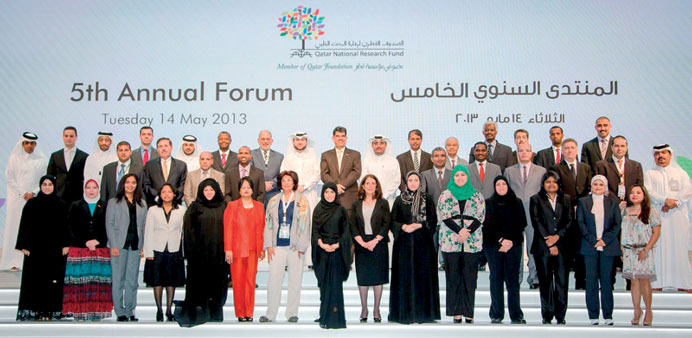
“QNRF has gained global recognition with credible programmes over the past seven years while research is helping to define Qatar’s future and also the transformation to a knowledge-based economy,” he said in his opening address at the fifth Annual Forum yesterday.
The Qatar National Research Strategy (QNRS) launched last year with a view to achieve Qatar National Vision 2030, is aimed at making Qatar as an international centre for research and development excellence and innovation, al-Suwaidi recalled.
The QNRS ensures that research agenda is well aligned with Qatar National Vision 2030’s four pillars, namely Human Development, Social Development, Economic Development, and Environmental Development.
“We should attract and retain world-class talent so as to promote research and development,” the official said while observing that Qatar has committed 2.8% of GDP to research.
“We will identify and address grand challenges facing the country. The Qatar National Research Strategy Forum 2013, being held on Wednesday and Thursday tackle the nation’s most pressing research challenges,” he said.
Asserting that innovation is key to all the pillars of QNRS, al-Suwaidi urged to be mindful of the innovation value chain and what comes after research. “Help connect those who will take the next steps,” he said.
Expressing confidence that Qatar can pioneer a new culture of research, the official outlined that going forward Qatar Foundation’s research activities will be under the one roof of QNRF, which manages about 40% of the research budget of the country.
QNRF yesterday announced new research grants worth a total of $121mn, under its flagship National Priorities Research Programme (NPRP), to 137 proposals submitted by 27 local research institutions in January this year to its sixth cycle.
Qatar University bagged the biggest chunk, almost $54mn, followed by Texas A&M University at Qatar ($17.18mn), Hamad Medical Corporation ($10.12mn), and Weill Cornell Medical College in Qatar ($10.1mn).
The other winners of the awards are: Anti-doping Laboratory ($3.5mn), Aspire Academy ($1.02mn), Biotechnology Centre of Ministry of Environment ($1.04mn), Carnegie Mellon University in Qatar ($1.86mn), ConocoPhillips Water Technology – QSTP ($700,000), Fikra Consulting & Research ($1.97mn), General Electric – QSTP ($934,524), Georgetown University School of Foreign Service in Qatar ($612,118), Gulf Organisation for Research & Development ($1.76mn), Ministry of Environment ($420,650), Ministry of Environment’s Department of Animal Resources ($392,883), Northwestern University in Qatar ($1.05mn), Qatar Environment and Energy Research Institute ($5.55mn), Qatar Faculty of Islamic Studies ($735,112), Shafallah Centre ($2.05mn), Silatech ($559,407), Stenden University – Qatar (235,394), Supreme Council of Health ($1mn), Transport Research Laboratory – QSTP ($668,130), Unesco Doha ($630,463), University College London – Qatar ($1.01mn), University of Calgary – Qatar ($929,292), and Virginia Commonwealth University in Qatar ($881,490).