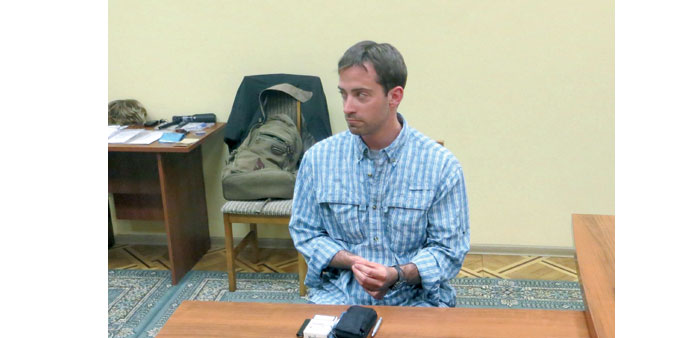
A handout still image released by the Russian Federal Security Service (FSB) shows Ryan Fogle at the FSB office in Moscow.
Reuters/Moscow
Russia has expelled a US diplomat after saying that he had been caught red-handed with disguises, special equipment and wads of cash as he tried to recruit a Russian intelligence agent to work for the CIA.
The announcement, a throwback to the Cold War, came at an awkward time for Washington and Moscow as they try to improve relations and bring the warring sides in Syria together for an international peace conference.
Russia’s Federal Security Service (FSB) said that Ryan Christopher Fogle, a third secretary at the US embassy in Moscow, had been detained overnight carrying “special technical equipment”, a disguise, a large sum of money and instructions for recruiting his target.
The foreign ministry summoned US Ambassador Michael McFaul to discuss the case today and released a statement demanding Fogle leave Russia without delay.
“Such provocative actions in the spirit of the Cold War will by no means promote the strengthening of mutual trust,” it said.
Russian television showed grainy footage of a man identified as Fogle being arrested, and the state-run Russia Today channel published photographs on its website that it said showed Fogle being detained in a blond wig.
In one photograph, a man lay face-down on the ground with his arms being pinned behind his back.
Another image showed two wigs, apparently found on him, as well as three pairs of glasses, a torch, a mobile phone and a compass.
Also displayed was a wad of 500-euro ($650) notes and a letter addressed to a “Dear friend”.
“This is an advance from someone who has been highly impressed by your professionalism, and who would highly value your co-operation in the future,” the letter said.
“We are willing to offer you $100,000 and discuss your experience, expertise and co-operation, and payment could be significantly larger, if you are willing to answer concrete questions,” it said, offering $1mn a year for long-term co-operation plus possible bonuses for useful information.
The FSB, a successor to the Soviet KGB, said Fogle worked for the Central Intelligence Agency (CIA) and that he had been handed over to embassy officials at some point after his detention.
The embassy declined comment. McFaul, a former adviser to President Barack Obama, was holding a live question-and-answer session on Twitter as news of the detention was announced, but refused to take questions on the matter.
McFaul has frequently been criticised by Russian media for his critical views on Russia and for meeting opponents of President Vladimir Putin.
More than two decades after the end of the Cold War, spying – and spy scandals – are still far from unusual.
The last major spy scandal was in 2010, when 10 Russian agents including the glamorous Anna Chapman were arrested in the US and later deported in exchange for four Russians imprisoned on charges of spying for the West.
US-Russian relations had thawed markedly under Obama’s first-term “reset” of ties, but have chilled again since Putin, himself a former KGB spy, returned to the presidency a year ago.
Putin has accused the US of encouraging protests against him, and Russia has ejected the US Agency for International Development and curbed US-supported NGOs in moves it says are aimed at preventing foreign meddling.
But both Obama and Putin have signalled they want to patch things up again, and the countries are trying to improve counter-terrorism co-operation after the Boston Marathon bombings.
FBI chief Robert Mueller visited Moscow for talks last week.
Samuel Charap, senior fellow at the International Institute for Strategic Studies, said Moscow’s response would show whether it wanted to continue the recent thaw.
“Does the Russian government do what the US did in 2010, and act quickly to defuse the issue, or does it use the incident to escalate tensions? That is the key question now.”
The foreign ministry said the incident raised “serious questions for the American side” at a time when Putin and Obama had “affirmed readiness to broaden bilateral interaction, including ... in the fight against international terrorism”.
Matthew Clements, Eurasia analyst at IHS Janes, said the row would probably blow over: “On the higher level ... both countries have always been adept at isolating these incidents from wider relations.”
Alexei Mukhin, director of the Moscow-based Centre for Political Information, said Putin would “make sure that this situation doesn’t get out of hand”.
He said US-Russian ties would be “hard to ruin” because, after the strains of the past 18 months, they could hardly get much worse.