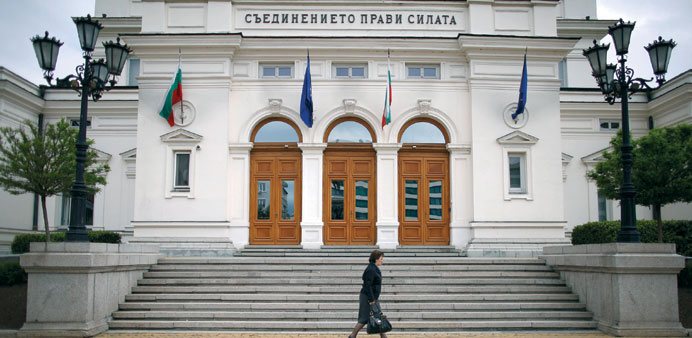
A woman walks past the parliament building in Sofia yesterday. Bulgaria’s centre-right GERB emerged yesterday as the winner of national elections but faced a struggle to form a government, suggesting no early end to the political stalemate that has gripped the European Union’s poorest country.
Reuters/Sofia
The centre-right GERB has emerged from Bulgaria’s election as the largest party but it is short of coalition options, and any new government will almost certainly need backing from a nationalist party which alarms the European Union.
GERB, whose leader Boiko Borisov resigned from government in February during nationwide protests in the EU’s poorest country, won most votes in Sunday’s poll but not enough to gain a majority.
The second-placed Socialists said that they would try to ensure GERB did not return to power, offering to set up a technocrat government that would also require the backing of the nationalist Attack party.
Borisov’s GERB is mired in allegations of corruption and the outspoken leader has kept a low profile since the vote, not speaking publicly or making grandiose claims of victory.
An extended political deadlock could crimp already lacklustre economic growth – expected to be about 1% this year – and mean further delays in reforms in areas such as employment, health and education.
“There is nothing dramatic if we cannot form a government. But for the others after us, it will be extremely hard, too,” said Ivailo Moskovski, a senior GERB member and former minister.
Other parties were reluctant to work with GERB, which won 30.7% of votes cast on Sunday and will have first go at forming a government, according to nearly complete results.
GERB could command a tiny majority if it worked with Attack.
Attack, whose members sometimes wear swastika-emblazoned shirt and make Nazi salutes at rallies, attracted Bulgarians unhappy with the low living standards and widespread corruption, have also ruled out for now support for GERB.
Its leader Volen Siderov has alarmed investors with his pledges of nationalisations and revoking foreign companies’ concessions.
“Coalition talks are likely to be uneasy,” said Otilia Simkova, an analyst at Eurasia. “Negotiations in forthcoming hours and days will be crucial for Bulgaria’s policy direction in next four years.”
An interim government will lead the Balkan country until a new cabinet is elected.
Yesterday Interim Prime Minister Marin Raikov appealed to political parties to avoid “burning bridges” in order to form a stable government.
“If we have an unstable government, a government that yields to social demagoguery, this will sink the country,” Raikov told reporters.
GERB pledges to keep fiscal deficit and debt under control, while the Socialists have promised to spend more and create more jobs without running up debt.
Attack is pursuing an immediate raise in the minimum wage and spending to increase living standards.
Widespread disenchantment with the voting process was reflected in turnout figures of just 53%, the lowest for any parliamentary election since the fall of communism in 1989.
Six years after joining the EU, many of Bulgaria’s 7.3mn people are angry about low living standards and graft, following a campaign that consisted more of mud-slinging than presenting clear policies, and was marred by scandals over wiretapping and illegal ballots that hurt GERB’s support.
The unclear result of Sunday’s election raises questions over economic policy and could mean another ballot will be needed, possibly in September, analysts and pollsters said.
With 99.3% of ballots counted, the Socialists were in second place, with 27.6% of the vote. Ethnic Turkish party MRF had 10.5% and nationalist Attack 7.4%.
That would give GERB 98 seats in the 240-member parliament and it could command a slim majority with backing from Attack, as it did to form a government in 2009.
Attack’s Siderov ruled that out on Sunday though that may be a negotiating position that could be softened.
The Socialists and their likely allies are set to get 119 seats when 121 are needed to form a government, meaning they would need Attack’s backing to form a cabinet, almost complete official results showed.
Socialist leader Sergei Stanishev has remarked that he was certain that GERB would not be able to form a government and that his party was ready to hold negotiations with MRF, Attack and citizens’ organisations to form a cabinet to avoid new protests.
“The first task is to get GERB out of power,” Stanishev said. “We will take the responsibility to form a government.”