


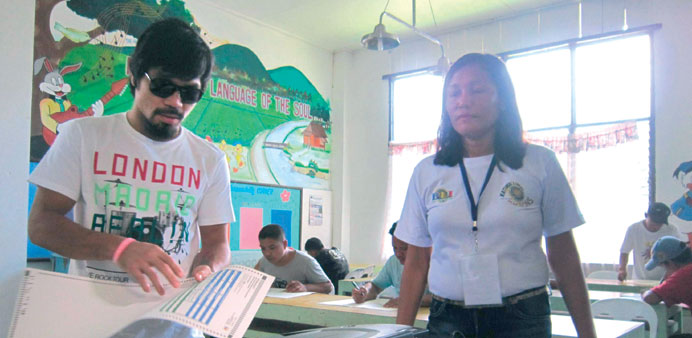
Philippine boxing icon, Manny Pacquiao, casts his vote during elections in Kiamba town, Sarangani
province, in the southern island of Mindanao yesterday.
KEY FACTS
The Philippines is holding mid-term elections, which are seen as crucial to popular President Benigno Aquino’s reform agenda.
Below are key facts and figures on the Philippines and its political system:
THE COUNTRY AND ITS POLITICAL SYSTEM
* The Philippines became an independent nation in 1946, following more than 400 years as a colony of either Spain or the US. National languages are Tagalog and English. Its system of government is a US-style democracy with a president, a bicameral legislature and an independent judiciary.
* The developing nation is plagued with widespread poverty, various insurgencies and corruption. Unemployment is high and about 27% of its 100mn people live on a dollar a day or less.
Nearly 10% of the population live overseas, seeking a better life abroad.
THE ELECTORATE
lThere are 52mn Filipinos aged at least 18 who are qualified to cast their votes. Voting is non-compulsory and elections since the fall of dictator Ferdinand Marcos in 1986 have had high turnouts, between 70 and 76%.
ELECTION FIGURES
* A total of 18,053 posts are being contested, most of which are local level positions such as for town councils. There are also more than 1,600 town mayoral posts up for grabs, and 80 provincial governorships.
* Half of the 24 seats in the Senate are also on offer, as are all the seats in the lower house.
WHAT IS AT STAKE?
* Aquino wants to secure majorities in both houses of Congress to ensure he can push through legislation in the final half of his six-year term that he says is vital to his reform agenda.
* One key piece of proposed legislation would expand the tax base to pay for more spending on social security programmes.
* Aquino also wants to pass a law reforming the mining sector, requiring firms to pay more taxes and accept greater environmental responsibility.
* Congress would also be required to ratify an expected peace deal with rebels who have waged a decades-long war in the south of the country that has claimed an estimated 150,000 lives and stunted economic growth.
ELITE RULE
* The country is run by remarkably few political families. A recent study showed 70% of members of the current lower house, and 80% of senators, belonged to a political dynasty.
* Political activists and analysts say elite rule is set to be more deeply entrenched at these elections, citing as an example the likely dominance of powerful politicians’ relatives for the 12 available Senate seats.
VIOLENCE
* Philippine politics has a long history of violence. Politicians, particularly at local and provincial levels are willing to bribe, intimidate or kill to ensure they win. Rebels also carry out attacks to extort money from candidates. More than 60 people were killed in violence ahead of yesterday’s vote.