


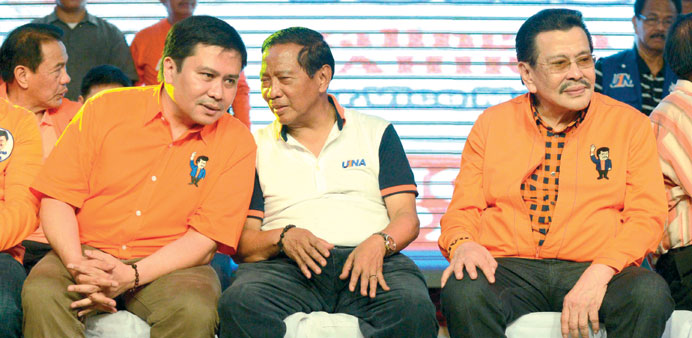
Photo taken on March 31, 2013 shows Philippine Vice-President Jejomar Binay (centre) talking to Senator Jinggoy Estrada (left) while Jinggoy’s father, and former president Joseph Estrada, who is running for mayor in the city of Manila, listens, during a political rally.
DPA/Manila
Former president Joseph Estrada is running for mayor of Manila in mid-term elections in the Philippines, while one of his sons is vying for a seat in the Senate, where he would join a brother if he wins.
One of Estrada’s grand-daughters is also running for councillor and a niece is contesting a congressional seat in nearby San Juan City.
Five other nephews and nieces of the 75-year-old former leader are seeking re-election for various positions in local governments in the provinces of Laguna and Quezon, south of Manila.
Estrada was ousted by a military-backed mass uprising in 2001 and convicted of corruption in 2007, but later pardoned. He shrugged off criticism that he was building a political dynasty beyond the family political base of San Juan City. “We are a democracy and the people have the right to choose who they want to vote for,” he said. “Let the voice of the people be heard.”
All over the Philippines, family members are running for one of 18,000 positions up for grabs in the elections today, including 12 seats in the Senate and more than 200 in the House of Representatives. In many provinces, the list of candidates is a virtual family tree with several generations of relatives seeking office.
According to studies by the Centre for People Empowerment in Governance, political power is controlled by less than 1% of the Philippines’ estimated 94mn-strong population.
“Studies also show that candidates who are able to beat a ruling political dynasty eventually form their own dynasties, so there is this self-perpetuating mechanism embedded in political dynasties,” said Bobby Tuazon, director for policy studies at the centre.Efforts to redistribute political power and encourage new blood to join politics through a proposed anti-dynasty law have failed to get the majority support of legislators, up to 80% of whom come from political dynasties.
The law is needed to implement an anti-dynasty provision that was enshrined in the 1987 constitution under late president Corazon Aquino, herself a member of a prominent dynasty.
Juan Edgardo Angara, a former congressman now running for the Senate, where his father is ending a six-year term, admitted that it had been an uphill battle for the proposed legislation.
An anti-dynasty bill was filed in the Senate in 2005 and a separate measure proposed in the House in 2010. Both measures are still in the early stages of deliberations.
Angara said a key stumbling block had been how to define the parameters of the prohibition: “Should it be parents, children and siblings only? I think including uncles and aunts and cousins is too much already.”
Under the proposed House version, Angara would not have been allowed to run in today’s elections. But the 40-year-old politician argued recently that “everyone must be given equal opportunity to serve.”
Eirene Aguila of the Anti-Dynasty Movement - a group seeking to enact a law by public petition to avoid waiting for legislators to act - agreed that the political system must give all Filipinos a chance to participate.
“That’s why we really need to address the dynasty situation soonest so that we have time for new leaders to emerge by 2016,” she said, referring to the next national elections.
“If we don’t, the risk is that we recycle names, slogans and promises.”
The group proposes that relatives up to the fourth degree be prohibited from being candidates if a family member already holds an elected position.
The petition needs to gather signatures of support from at least 10% of the 52mn registered voters, and would then have to be verified by the Commission on Elections. The country’s democracy would not be sustainable and credible in the long run if dynasties are not abolished, said Ronald Mendoza, executive director of the Asian Institute of Management’s Policy Centre.
Political dynasties promote a system where policy decisions and public allocations are made “not to reduce poverty or to produce jobs, but to keep themselves in power,” he said.
A study by the centre showed that dynasties typically thrive in impoverished areas, where the poor often have no option but to support the ruling power to ensure their basic needs.
Mendoza said it is important for the government to improve economic equality and ensure that growth benefits the poor as part of efforts to change the country’s leadership structure.
“If the government is not there to help them, if taxpayers, the middle-class people are not supporting strong social safety nets, these poor people have no other choice but to go to their patrons, who are the political dynasties,” he said.