


|
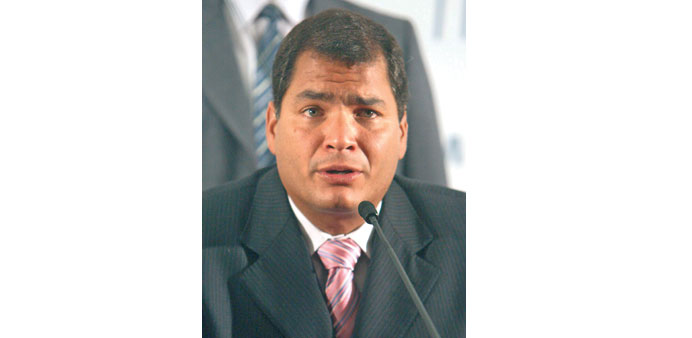
Ecuadorean President Rafael Correa has appointed a new oil minister and a new finance minister, as the socialist leader unveiled a new cabinet for his third term in office. |
Correa, a member of an alliance of left-wing Latin American presidents, won re-election in February with about 57% of the vote.
His inauguration ceremony is scheduled for May 24.
“We have to be very critical with ourselves and revolutionise the revolution,” said Correa at the presidential palace, as he encouraged his new cabinet to deepen the socialist policies that his government has been implementing since he first took office in 2007.
Oil minister Wilson Pastor has been replaced by Pedro Merizalde, head of the Pacifico refinery project.
Correa named Fausto Herrera as finance minister, replacing Patricio Rivera, who has been appointed minister for economic policy, and will oversee the work of the finance ministry, the central bank and the tax office.
Herrera has served as deputy finance minister since October 2012, and was in charge of securing financing for state spending and administering the national budget.
Correa named nine new ministers in total, including those responsible for culture, production and education.
Some of the cabinet changes had already been announced by a high-ranking government official on April 30.
Correa has won broad support from the country’s low-income majority with heavy spending on welfare, healthcare, education and infrastructure projects.
However, the US-trained economist has irked investors by using anti-capitalist rhetoric, defaulting on $3.2bn of debt, making oil companies sign less-profitable service contracts and pushing through a new constitution that gave him more power.
Correa is expected to continue spending heavily on the poor and implementing policies to give the state more control over the economy.
The new cabinet is not expected to usher in policy changes, because most of the new ministers already work for the government or are members of the ruling Alianza Pais party.
Merizalde will be expected to attract more foreign investment, since oil companies have failed to carry out new exploration projects since 2010, when they were required to sign service contracts.
The country’s oil output has been stuck at 500,000 barrels per day (bpd) since then.
The smallest member of Opec is now trying to lure investors to several projects.
It needs to secure financing for its ambitious $12.5bn Pacifico oil refinery – a joint venture between state-run PDVSA of Venezuela and Petroecuador – so that it can come online in 2016, as scheduled.
The country also hopes to attract around $1bn in investments for 16 oil blocks in its Amazon region, even though indigenous groups oppose oil exploration on their lands.