


|
|
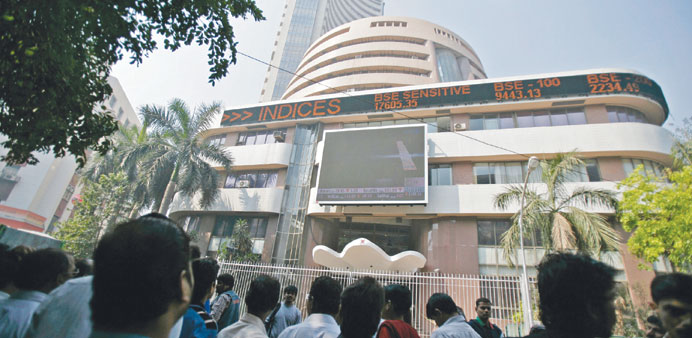
India’s benchmark stock index climbed to its highest level in more than three months as foreign funds extended this year’s record purchases of the nation’s equities.
The S&P BSE Sensex jumped 1.1% to 19,888.95, the highest close since January 31. Volume on the gauge was 20% below the 30-day average. ITC, which has businesses varying from cigarettes to hotels, jumped 2.8% to a record. ICICI Bank, the nation’s largest private lender, climbed 1.9%, the most in two weeks.
Lower borrowing costs from Europe to the US and Japan have stoked inflows into emerging markets. The European Central Bank reduced rates to a record low last week and the Federal Reserve said it will keep buying $85bn of bonds a month to stimulate the US economy. Foreign funds bought a net $802mn worth of local shares last week, the most in 12 weeks. That took their purchases this year to $11.8bn, a record for the period, data show.
“The policy stance taken by central banks from Europe to Japan has caused liquidity to gush out to markets around the world,” Jitendra Sriram, director and head of research at HSBC Securities and Capital Markets (India) in Mumbai, told Bloomberg TV India yesterday.
ITC contributed the most to gains in the Sensex. The stock jumped the most since June 29 to a record Rs335.3. ICICI Bank added 1.9% to Rs1,163.95 in a second day of gains after losing 3.6% on May 3. HDFC Bank, the second-largest private lender, rose 1.9% to Rs688.05.
Foreign funds have been net sellers of Indian equities in just two of the past 13 years, based on data compiled by Bloomberg going back to 2000. They invested a net $24.5bn last year, the most among 10 Asian markets tracked by Bloomberg, which helped the Sensex climb 26% in 2012, its biggest gain in three years.
“Global liquidity has increased further and this huge liquidity is going to last for some time,” Raamdeo Agrawal, joint managing director at Motilal Oswal Financial Services in Mumbai, told Bloomberg TV India.
The Sensex capped a third week of advances on May 3, the longest run since December. The gauge has rebounded 9.1% since falling to a seven-month low on April 9, as foreign funds stepped up equity purchases amid optimism the Reserve Bank of India would cut interest rates at its May 3 policy review. While the RBI pared funding costs that day, Governor Duvvuri Subbarao told Bloomberg TV India in a May 4 interview that the possibility of further easing is “practically non-existent.”
The Sensex has advanced 2.4% in 2013 and trades at 13.7 times projected 12-month profits, compared with a multiple of 10.6 times for the MSCI Emerging Markets Index. The gauge’s 50-day volatility, a measure of price swings, has risen to the highest level since August 8.
The 50-stock CNX Nifty Index rose 1.2% to 6,043.55, its highest close since January 30. Its May futures settled at 6,050.30. India VIX, which measures the cost of protection against losses in Nifty, jumped 4.2% to 16.5.
Bharti Airtel, the largest mobile-phone operator, rallied 3.3% to Rs331.20, its highest level since January 31. Tata Motors, owner of British luxury car brands Jaguar and Land Rover, jumped 2.5% to Rs298.4, the most since April 25. Hero MotoCorp, the biggest motorcycle maker, climbed 3.5% to a two-month high of Rs1,706.35.
Meanwhile, Indian rupee snapped a three-day losing streak on optimism monetary easing by global central banks will boost inflows into higher-yielding emerging markets. Bonds advanced.
The rupee had weakened earlier as central bank Governor Duvvuri Subbarao said on May 4 that the odds of further monetary easing to spur growth are “practically non-existent.”
“Continued monetary accommodation by major central banks is supportive of robust capital inflows,” analysts at ICICI Bank, including Mumbai-based Sunandan Chaudhuri, wrote in a report yesterday. “The cautious policy stance of the RBI” has been among concerns that have capped the rupee’s gains, they wrote.
The rupee advanced 0.1% to 54.1450 per dollar in Mumbai, after earlier dropping as much as 0.3%. One-month implied volatility, a gauge of expected moves in the exchange rate used to price options, fell three basis points, or 0.03 percentage point, to 8.55%.
Foreigners bought a net $497mn of Indian shares in the first three days of this month, exchange data show, after adding $1.2bn to holdings in April, the least since June 2012.
The Reserve Bank of India lowered its repurchase rate to 7.25% from 7.5% last week, taking this year’s reduction to 75 basis points, or 0.75 percentage point.
“The baseline case is that the possibility of easing is practically non-existent,” Subbarao said in the Bloomberg TV interview. Any expectation that the outlook is for “another salvo” of loosening is “inaccurate,” he said, adding inflation and the current-account gap will determine future policy changes.
The current-account gap probably widened to an all-time high of around 5% of gross domestic product in the fiscal year ended March 31, the governor said in a conference call with analysts on Monday, adding that the deficit is expected to shrink in the current period.
The RBI bought 96.6bn ($1.8bn) of debt due in 2017, 2024, 2025 and 2032 yesterday, the monetary authority said in an e-mailed statement.
The yield on the 8.15% bonds due June 2022 dropped to 7.74% from 7.75% yesterday in Mumbai, according to the central bank’s trading system.
Three-month onshore rupee forwards traded at 55.14 per dollar, compared with 55.19 on Monday. Offshore non-deliverable contracts were at 54.78 versus 54.90.