


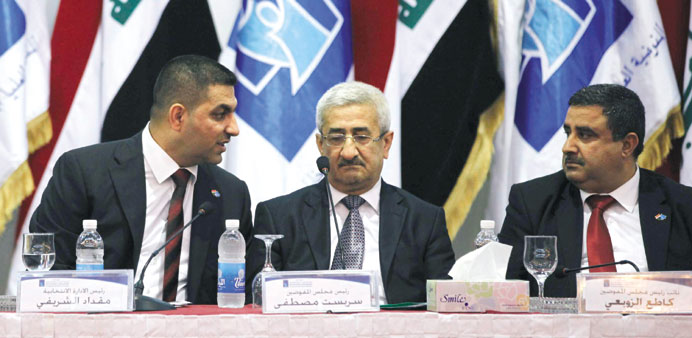
Sarbast Mustafa (centre), chairman of the Independent High Electoral Commission of Iraq, attends a news conference with colleagues Muqdad Hassan (left) and Katee Mukhlif to announce the final results of the provincial elections in Baghdad yesterday.
AFP/Baghdad
Iraqi Prime Minister Nuri al-Maliki’s State of Law coalition won the most provincial council seats in seven of the 12 provinces that voted, according to results released yesterday.
However, no list won a majority of seats in any of the provinces.
The vote for provincial councils was the first election held since US troops withdrew from Iraq in late 2011, and was seen as an important gauge of Maliki’s popularity ahead of a general election next year.
State of Law led in Baghdad, Karbala, Babil, Diwaniyah, Basra, Dhi Qar, and Muthanna provinces, and tied for first with Supreme Iraqi Islamic Council chief Ammar al-Hakim’s Citizen’s Coalition in Wasit—all of them either Shia-majority or mixed provinces.
Powerful Shia cleric Moqtada al-Sadr’s movement led in Maysan province, while local lists won the most seats in Diyala, Najaf and Salaheddin provinces.
The Citizen’s Coalition came second in Najaf, Babil, Diwaniyah, Basra, Dhi Qar, Muthanna and Wasit provinces.
State of Law was second in Maysan, while Sadr’s movement was runner-up in Baghdad and Karbala. Parliament speaker Osama al-Nujaifi’s list tied for second with a local list in Salaheddin, and a local list was second in Diyala.
Turnout for the provincial vote was about 51%, according to officials from Iraq’s Independent High Electoral Commission. Security forces voted on April 13, while the general vote was held on April 21.
But six Iraqi provinces did not vote.
The three making up the autonomous Kurdistan region are to vote later this year, as are Anbar and Nineveh, where polls were delayed because authorities said security could not be guaranteed.
Provincial council elections have not been held in Kirkuk province since 2005 because of a lack of agreement between its various ethnic groups.
The credibility of the elections came into question because of the six provinces not voting and attacks that killed more than a dozen candidates.
The elections, a decade after US-led forces ousted now-executed dictator Saddam Hussain, were the first since parliamentary polls in March 2010, and also the first time Iraqi forces secured elections without support from American or other international forces since 2003.
US troops withdrew in December 2011.