


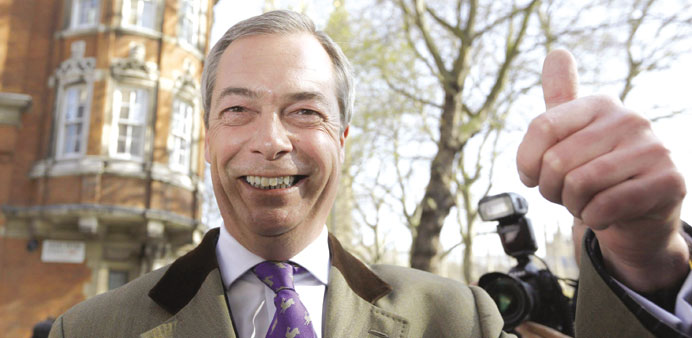
UKIP leader Nigel Farage arrives at Milbank studios in London yesterday.
AFP/London
The anti-immigration UK Independence Party (UKIP) broke through as a major political force yesterday following local elections which delivered a bloody nose to ruling coalition.
UKIP leader Nigel Farage said his eurosceptic party could no longer be dismissed as a protest movement as it averaged almost one quarter of the vote in local authority elections in England.
“This is a real sea-change in British politics,” Farage said shortly before heading to the pub for a celebratory drink.
Prime Minister David Cameron’s Conservatives appeared hardest hit by UKIP’s surge, and he acknowledged the success of the party he once dismissed as full of “fruitcakes, loonies and closet racists”.
“We need to show respect for people who have taken the choice to support this party and we are going to work really hard to win them back,” Cameron said.
The BBC put the projected national vote share for UKIP at 23%, as it secured more than 120 council seats in Thursday’s voting.
The opposition Labour party, which has been leading opinion polls amid a government austerity drive and stagnating economy, led the field with 29%, and won modest gains of more than 240 seats.
The Tories came in second place with a projected 25% national share, after losing about 250 seats and ceding control of 10 councils, although they still controlled 17.
Their junior coalition partners, the Liberal Democrats, were pushed by UKIP into fourth place with 14%.
UKIP still does not have a single member of parliament and will struggle to translate its local election success into victory at the 2015 national election. But the results are a major breakthrough and bode well for its prospects in European Parliament elections next year.
“We have been abused by everybody, the entire establishment, and now they are shocked and stunned that we are getting over 25% of the vote everywhere we stand across the country,” said Farage, a charismatic MEP.
The coalition parties were braced for losses in the mid-term elections, which are often used by voters to punish ruling parties. But the results were sobering for the government, particularly in the parliamentary by-election in South Shields, northeast England, which took place at the same time.
Labour held the seat, vacated by former foreign minister David Miliband, although its majority was almost halved. UKIP came second with 24% of the vote, followed by the Tories in a poor third place and the LibDems in a humiliating seventh, with just 352 votes.
“I think there are major lessons for the major political parties,” Cameron said in his Oxfordshire constituency, where the Tories lost control of the local council. Asked if he stood by his “fruitcakes” attack on UKIP, the prime minister said: “Well, look, it is no good insulting a political party that people have chosen to vote for.”