


|
|
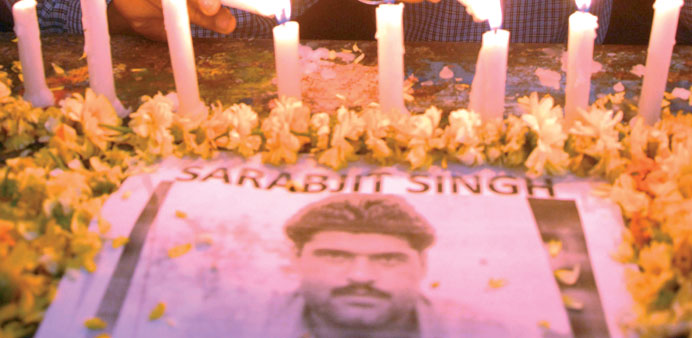
Sarabjit Singh finally returned home yesterday - for a final adieu. Six days after a murderous attack by fellow prisoners, the Indian death row prisoner died in a Lahore hospital in the early hours of the morning, leaving thousands in India mourning his death and pushing the India-Pakistan equation to a new low.
There were tears and outrage as his body was brought back home in a special Indian aircraft from Lahore to Amritsar. It was later taken by helicopter to Bhikiwind, his hometown in Punjab.
Crowds jostled to catch a glimpse of the casket of the man who had crossed over 23 years ago into Pakistan and was returning for what is to be a state funeral today.
It was at 12.45am Pakistan time (1.15am IST) that Lahore’s Jinnah Hospital announced Singh was dead, bringing to an end a saga that began on a fateful August day in 1990 when he entered Pakistan, apparently by mistake.
While Pakistan declared him a terrorist and convicted him for bombings in Lahore and Multan that left 14 dead, his family claimed the devoted brother, husband and father from a poor rural family in Punjab had crossed over in an inebriated state when he was just 26.
Most of the years since were spent in anonymity but in death Singh - who on April 26 was brutally assaulted with bricks and plates in Lahore’s Kot Lakhpat jail and had slipped into a deep coma - became the latest bone of contention between the troubled neighbours.
India’s ministry of external affairs did not mince its words either and said Singh’s death was “put simply, the killing of our citizen while in the custody of Pakistan jail authorities.”
From Prime Minister Manmohan Singh to the Bharatiya Janata Party, leaders across the political spectrum expressed their deep anguish at the death of the 49-year-old.
“I am deeply saddened by the passing away of Sarabjit Singh. He was a brave son of India who bore his tribulations with valiant fortitude,” the prime minister said.
In a strongly worded statement, he said: “It is particularly regrettable that the government of Pakistan did not heed the pleas of the government of India, Sarabjit’s family and of civil society in India and Pakistan to take a humanitarian view of this case.”
As a string of VIPs, including Home Minister Sushilkumar Shinde and Congress vice president Rahul Gandhi, went to pay their condolences to Singh’s sister Dalbir Kaur, the BJP upped the ante and demanded that diplomatic relations with Pakistan be scaled down.
“The level of diplomatic relations should be scaled down and for the time being Indian high commissioner to Pakistan should be called back,” BJP president Rajnath Singh said.
Attacking the government on the emotive issue, others spoke out too, including Trinamool Congress’ Mamata Banerjee who said: “This is the result of bad handling of the case.”
But Dalbir Kaur, Singh’s doughty sister who waged a long and hard battle to highlight her brother’s case, asked all political parties to come together and strengthen the government’s hands.
“He was martyred for India. (Pakistan President Asif Ali) Zardari killed him because of elections,” Kaur told reporters here.
She said: “The entire country should come together. I appeal to all parties to strengthen the hands of Prime Minister Manmohan Singh and Home Minister Sushilkumar Shinde.”
Kaur, who along with Singh’s wife and daughters returned from Pakistan on Wednesday claiming they were not being given information on his condition, claimed her brother had written to her that Pakistani authorities had asked him to undergo training in terror camps.
The postmortem examination was conducted yesterday morning, said Sarabjit’s lawyer in Pakistan Awais Sheikh.
The government of Pakistan’s Punjab province also ordered a judicial probe.
Pakistan insists regular consular access was granted to Singh and said doctors did everything possible to save him before his death from cardiac arrest.
“The prisoner, who had been in a comatose state and on a ventilator for the last few days, was being provided the best treatment available and the medical staff at Jinnah Hospital had been working round the clock... to save his life,” the foreign ministry said.
The government provided “all assistance” to Singh’s family and the Indian authorities, and will facilitate “the early completion of all formalities” and hand over his body “at the earliest possible” time, it added in a statement.
Two prisoners were taken into custody immediately after the attack and have now been charged with his murder, police official Tariq Mehmood said.
The motive was unclear, but Pakistani police say an initial investigation pointed to an exchange of “hot words” with Singh.
Pakistani analysts doubted the death would have a significant impact on tense relations between New Delhi and Islamabad.
“It may increase tension for a while as the hawks in India could put pressure on the Indian Congress (ruling party) to criticise Pakistan for lack of security,” retired lieutenant general Talat Masood said.
But Indian Foreign Minister Salman Khurshid told reporters in Delhi that the India-Pakistan relationship had been hurt by this “terrible tragedy.”
Singh will be cremated in his hometown Bhikhiwind in Punjab’s border district of Tarn Taran today.
His family reached Bhikhiwind, 50km from Amritsar, by helicopter yesterday evening. Scores of local residents gathered at the helipad to meet them and walked with them to their house.
Angry resident of the town held protests yesterday and kept the entire town shut. Shops and educational institutions also remained closed.
Protesters gathered at various places and condemned the “cowardly” act by Pakistani authorities.
The residents of the town saw celebrations and disappointment within a few hours in June in 2012 when reports first said that the Pakistan government had announced Singh’s release.
However, in a flip-flop, the Pakistani authorities later clarified that it was not Sarabjit Singh but another Indian prisoner, Surjeet Singh, who was being released.