


|
Religious violence that saw mobs attack mosques and torch homes left at least one dead in central Myanmar, officials said yesterday, as anti-Muslim unrest crept closer to the commercial hub Yangon. |
A Muslim woman was among those being held after authorities said she accidentally bumped into a young monk in the street on Tuesday sparking rioting in the small town of Oakkan, around 100 kilometres north of Yangon.
Myanmar is in the grip of acute religious tension after a wave of unrest in March that saw monks and Buddhist mobs attack Muslim areas in violence that spread towards the country’s main city.
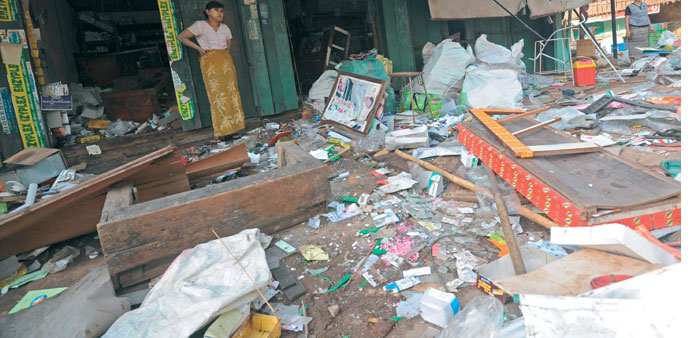
Two mosques and more than 80 homes in four villages around Oakkan were damaged or destroyed in the latest attacks, according to a local government official, who asked not to be named.
“A 29-year-old man died of his injuries and nine others were also hurt during yesterday’s violence,” he said, adding that calm had been restored.
He said 18 people were arrested over their involvement in the unrest and Win Win Sein, the woman who had knocked into the novice monk, was also being held, although he did not give a reason for her detention.
Terrified villagers of both faiths said police were not there to protect them when a crowd attacked a local mosque on Tuesday evening in Mie Laung Sakhan village, near Oakkan.
“About 200 to 300 people arrived in our village on motorcycles and destroyed the mosque. All the villagers ran away. We were scared and didn’t resist. They destroyed until they were satisfied,” said Soe Myint, 48, a Muslim. The mosque was seriously damaged and around 10 homes burned, according to an AFP journalist at the scene.
“Even we were threatened to be killed. We are also scared. We need security urgently,” said Than Soe, a Buddhist.
A heavy security presence was visible yesterday morning in Oakkan, where some 30 shops in the market had been destroyed and another mosque damaged.
Attacks against Muslims - who make up an estimated 4% of Myanmar’s population - have exposed deep fractures in the formerly junta-run country and cast a shadow over reforms under a quasi-civilian regime that took power two years ago.
President Thein Sein, who was criticised for waiting days to speak out during the last round of violence, is set to address the nation on Thursday morning, state media reported late yesterday. At least 43 people were killed and thousands left homeless in March in fighting apparently triggered by a quarrel between a Muslim gold shop owner and Buddhist customers in the central town of Meiktila.
Some monks were involved in those clashes, while others are behind a nationalistic campaign calling for a boycott of Muslim-owned shops.
Muslim residents in Mie Laung Sakhan were urged to hide as the mob descended on their village.
Win Hlaing said local Buddhists had tried to help their Muslim neighbours. “We have been living together for a long time and have had no problems at all,” the 60-year-old said.
Last year around 200 people were killed in clashes in Rakhine state between Buddhists and Muslim Rohingya - a minority treated with hostility by many Burmese, who see them as illegal Bangladeshi immigrants.
Human Rights Watch last week accused authorities of being involved in “ethnic cleansing” in Rakhine - a claim rejected by the government.
An official probe into the Rakhine unrest this week suggested doubling the security presence in the state, and recommended keeping the communities apart as a temporary measure to prevent further violence.
The UN yesterday acknowledged the report’s call for an urgent increase in humanitarian aid to the state, where some 140,000 people are in squalid camps and vulnerable to the impending monsoon.
UN Resident and Humanitarian Coordinator Bertrand Bainvel urged the government to help aid workers access the displaced and “take action against all forms of incitement”.
.