


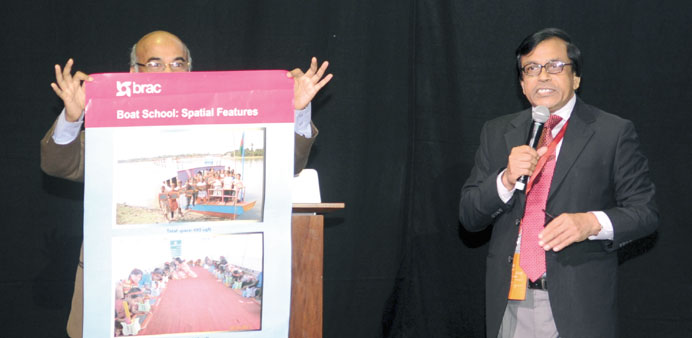
Dr. Shafique Ul Islam, Director of BRAC Education Programme from Bangladesh, explaining boat school concept.
By Joseph Varghese/Staff Reporter
The second and concluding day of the high-level strategic meeting of the Educate A Child ( EAC) initiative discussed the barriers and innovations in reaching out of school children around the world.
Representatives of a number of NGOs from around the world took part in the discussions which focused on the major issues of primary education held at the Qatar National Convention Centre (QNCC) yesterday.
Moderating the session, Nat Fields, Director of Field Operations at Education Above All (EAA), the apex body of EAC, highlighted that there were four major areas to be focused. He explained: “Our focus is on cases of children living in rural and remote areas, children living in urban slums, girl children and children in displaced situations. These are the most underprivileged children in most of the cases and they need to be provided sustainable education.”
Speaking on the issue of children living in rural and remote areas, Dr. Shafique Ul Islam, Director of BRAC Education Programme from Bangladesh said that it was one of the most constraining factors in his country.
“Access to rural areas is the most challenging factor as more than six months most of the places are flooded. Conventional methods of education do not work here and we are using boat schools to reach to the children in these places,” he said.
He said the boats go to every house and collect children and conduct classes on board.
“Since we started boat school, there has been more enrollment. At present there are 200 boat schools in Bangladesh and around 18,750 children taught through this system,” he added.
Khyatti Bhatt from Gyan Shala in India highlighted the efforts of her organisation in providing quality education to the students of urban slums in different parts of India.
She said that around 38,000 children at 1,350 centres in fours states of the country were learning under the organisation.
“We have four different programmes. They are programmes for the elementary grades, for middle school, high school and the uneducated adolescent ladies.”
She pointed out that the programme was very cost-effective as it charged only $60 annually for the elementary classes including all the study materials and $80 for the middle level classes.
“The schools are providing quality education on par with most of the elite schools in India. This has been approved by a number of various international bodies,” she added.
Safeena Hussien, Executive Director of Educate Girls from India, narrated the plight of girl children in different areas of the country and the region.
She observed that India had the largest number of out of school girl children. “In some parts of the country 68% of girls are married off before they complete their primary education. Some of the girls get married off even before the age of 10. Child marriage, low status of women and caste system are the major factors of the plight of the girls in the country.”
She pointed out that there were significant improvements in the scenario with more than 50,000 girls being enrolled in her organisation for schooling.