


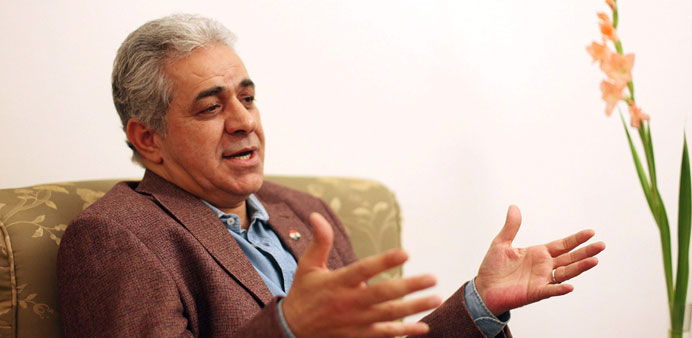
“If you look at any country the IMF has gone into, you will find that poverty has increased”
Reuters/Cairo
Egypt should refuse a $4.8bn loan from the International Monetary Fund rather than submit to terms that would further impoverish the poor and could spark a revolution of the hungry, leftist leader Hamdeen Sabahy said yesterday.
Sabahy, 58, who came third in a presidential election last year after the 2011 uprising that toppled autocratic president Hosni Mubarak, told Reuters that neither the global lender nor Egypt’s Islamist-led government had told the public the truth about austerity conditions attached to the proposed loan.
The firebrand leader of the Popular Current movement met an IMF team that visited Cairo this month for talks which ended without an agreement partly due to a lack of political consensus to support the accompanying economic reform programme.
Asked whether he would agree to the IMF’s conditions, Sabahy said: “No. I would not agree to them.”
“If you look at any country the IMF has gone into, you will find that poverty has increased,” he said in an interview in his modest 13th-floor apartment in a middle-class district of the capital. “Talk about plugging a budget deficit does not get food to the people.”
The conditions for an IMF loan have not been made public but Egypt, battling economic stagnation, rising inflation and unemployment, has twice baulked at raising sales tax on all goods and services and slashing fuel and food subsidies.
“If the political situation remains unchanged, the January 25 (anti-Mubarak) revolution will be followed by a new wave that could erupt due to poverty once the IMF conditions are implemented and there will be a revolution of the hungry,” Sabahy said.
Jailed several times for dissent and pro-democracy activism under Mubarak and former president Anwar al-Sadat, Sabahy often defended the Muslim Brotherhood under their autocratic rule, and he campaigned alongside them in Mubarak-era parliament elections.
He now accuses Islamist President Mohamed Mursi and his Brotherhood group of trying to monopolise power and sideline all opposition.
“The main reason for the severe political polarisation that Egypt has suffered for a long time is the insistence of Dr Mursi and the Brotherhood to control all state powers and their refusal of any serious co-operation with civil society or other political forces,” he said.
“Egypt is paying a high price for this roadblock.”
The Brotherhood were losing popularity fast because of their power grabs and failures in government, but public support was turning not to the democratic opposition but to the army, with many hoping for military intervention to restore order, he said.
“Many who abandon the Brotherhood do not have enough faith in the ability of the National Salvation Front to oust the Brotherhood and the force that has benefited most from that is the Egyptian army,” Sabahy said. The National Salvation Front is a loose alliance of secular, liberal and left-wing opposition parties, including Sabahy’s Popular Current movement.
Asked whether his movement would participate in parliamentary elections due later this year, he said it was up to Mursi to create the conditions by changing the government, replacing a reviled prosecutor general and passing a fair election law.