


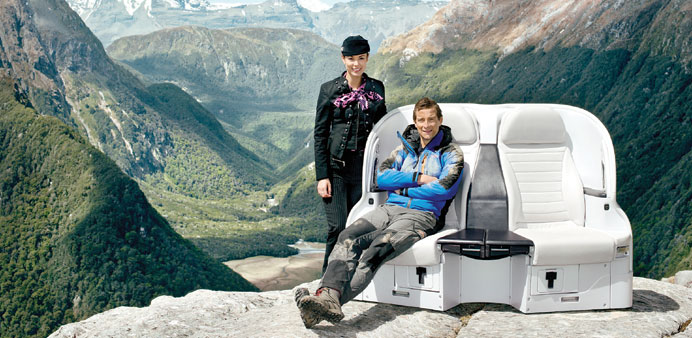
* A scene from one of Air New Zealand’s quirky safety videos puts luxury seats, a flight attendant and he-man adventurer Bear Grylls in front of one of a breathtaking New Zealand landscape. Photograph: Air New Zealand
By Cheryl Norrie
British adventurer Bear Grylls, who stars in a television series, Man vs Wild, runs through the mountains chasing a flightless bird for ‘lunch’ and eating a glow-worm as a face-puckering snack. So far, not so unusual.
But this is no ordinary video.
This is Air New Zealand’s latest in-flight safety video, where Grylls capers through the mountains of New Zealand’s Southern Alps, demonstrating life-jacket use by leaping in a fast-flowing river, stowing his backpack containing a large fish in a rock cavity and demonstrating escape-track lighting with a row of glow worms.
It’s the latest in a series of quirky videos being produced by airlines to persuade jaded frequent flyers to sit up and pay attention to safety messages.
Airlines in the United States have been some of the first to try something different, with Virgin America’s cute cartoon version in 2007 featuring an alien passenger, a matador demonstrating seat belt procedure, and an electronics-laden nun.
Delta Air Lines joined the trend last year, adding new twists to the standard production, and featuring a robot passenger turning himself off, and a passenger stowing his piano accordion safely under the seat in front.
But New Zealand’s national carrier, Air New Zealand, is one airline which has really championed the cause of creative airline safety videos. Its previous videos, including a Hobbit-inspired version featuring director Sir Peter Jackson, one featuring fitness guru Richard Simmons, and a notorious 2009 version in which flight crew appeared wearing nothing except body paint, have collectively clocked up more than 23mn views online.
An Air New Zealand spokesperson, Marie Hosking, said anecdotal evidence from flight crew suggested passengers were much more engaged and more likely to watch the safety videos if they were delivered in an entertaining way. “Passengers love our innovative and unexpected approach to in-flight safety videos.
“We have established a strong track record in turning what is a safety mandatory into a piece of genuine entertainment that people voluntarily choose to view on YouTube, outside of the aircraft environment.”
And many passengers would seem to agree.
A frequent flyer, editor Carolyn Enting, is a huge fan. “I do a lot of flying in my job but a few years ago I was a really nervous flyer and I hate it when you get on the aeroplane and you are feeling fine and then they remind you that you are going to crash before you even take off. So it just always makes me stressed.
“So what I love about the Air New Zealand safety videos is they make it really fun, and so when you are watching it you are smiling, you are laughing, you get the information but you are not thinking about plunging from a great height into the water or something.
“I just think they are really clever. This one with Bear is definitely one of my favourites because I love that whole adventure element and it is highly entertaining and it is funny.”
Not all passengers are converts, though and it seems the line between irritation and entertainment may be quite a fine one.
Columnist Jane Bowron wrote in local media that she was tired of being patronised “via a series of corny video clips featuring a loud has-been American exercise instructor, a contagion of Hobbits, a pack of All Blacks and now Bear Grylls to show small boys the versatility of oxygen masks he suggests can be used as portable urinals.”
Regardless, Australia’s national carrier Qantas says it too is devoting its energy to re-engaging the attention of its frequent flyers.
Previous Qantas videos have included Australian Olympians and Paralympians, the Australian Cricket Team, and a range of Qantas staff from baggage handlers to cabin crew. Hollywood star, and real life pilot, John Travolta has also featured.
Andrew McGinnes, head of external affairs and media at Qantas, said, “We refresh our safety videos on a regular basis, particularly to keep the attention of people who fly with us a lot.”
Singapore Airlines declined to comment on the introduction of an entertainment quotient into safety videos, with spokesperson Grace Chew saying only “Suffice to say, our customers’ safety is and always will be one of our top priorities.”
So far, the airline safety authorities seem happy with airlines lightening the information load with a dash of entertainment.
The manager of corporate communications at New Zealand’s Civil Aviation Authority (CAA), Mike Richards, said rules specified only that the videos must meet passenger briefing requirements, and the latest Air New Zealand video had been found to comply with this.
“CAA inspectors have also observed passenger behaviour on board aircraft when the video is in progress and have noted that there is a high degree of passenger attention. The CAA supports an approach of this nature which is both compliant and promotes passenger attention to items which affect their safety.”
Having pulled out all the stops to produce its latest video thousands of feet above sea level, Air New Zealand is congratulating itself on having leveraged an inflight safety video into a superb promotional tool.
The Bear Grylls video has so far attracted more than 2mn views on YouTube — with viewers seeing not just the airline showcased, but also New Zealand’s magnificent South Island mountain scenery — making it a boon for the tourist industry as well.
The Bear Grylls video can be viewed at http://www.airnzsafety.com