


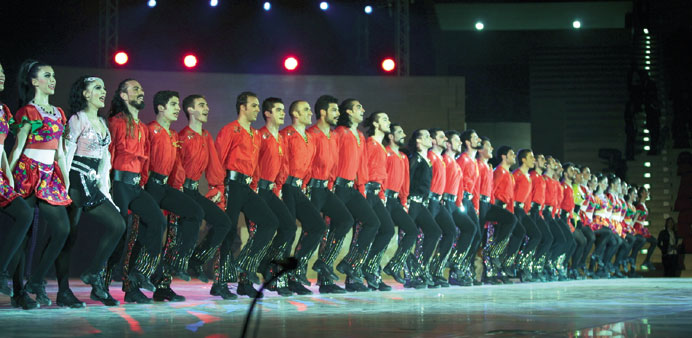
A view of the scintillating show at Katara Open Air Theatre.
The open air theatre at Katara - the Cultural Village - hosted a spectacular show by Turkish dance group, Fire of Anatolia on Thursday evening.
Under the stewardship of founder and general art director Mustafa Erdogan, nearly 40 dancers stepped, stomped and swirled to the beats of music from the Black Sea to the Balkans, embodying the conflict between life and death, war and peace as well as good and evil.
The director used several theatrical tools to articulate his concept through the use of lights, music and sound, as well as illuminated pictures accompanied by dancing. All these elements epitomised the diversity of Anatolian culture - a fusion of East and West.
The dances offered a mixture of Turkish folk, ballet, modern and oriental elements as well as countless motifs of many other dance disciplines, with a focus on appropriate clothing for each scene.
With the show featuring thousands of dance routines and music from each corner of Anatolia, it was like travelling through time to live an experience of crisis and war.
The troupe seemed to deliver the message through its performance that the fire that gutted Troy and brought tragedy and ruin for its people, also lit a candle of hope for the coming peace and the end of the war. The show attracted a large audience comprising people from different nationalities and ages. The viewers applauded every scene in the show, showing their appreciation with the efforts of Katara to bring the world’s best artistic groups to Qatar.
The group has performed in front of a combined audience of approximately 20mn people across the world, including in places such as Germany, the Netherlands, Switzerland, Lebanon, Russia, Hungary, Greece, Bulgaria and others. Fire of Anatolia is also the first dance group to perform in the Chinese parliament building. Critics, too, have agreed that Fire of Anatolia is one of the most famous dance groups in the world, besides being highly skilled in what it does.
Erdogan founded the group in 1999 and it achieved a lot of success in Turkey over the next three years. Buoyed by the response, he decided to take the group beyond Turkey in 2002. “The epic Trojan (War) has raised the curiosity of historians across the world and over a long period of time,” he said, about retelling the story of the Trojan War.
Erdogan, who was born in Hakkari (Turkey) in 1965, studied philosophy at Hacettepe University and public management at Gazi University. His stint at Bilkent University, where he studied folk dances, marked an important step in his career.