


|
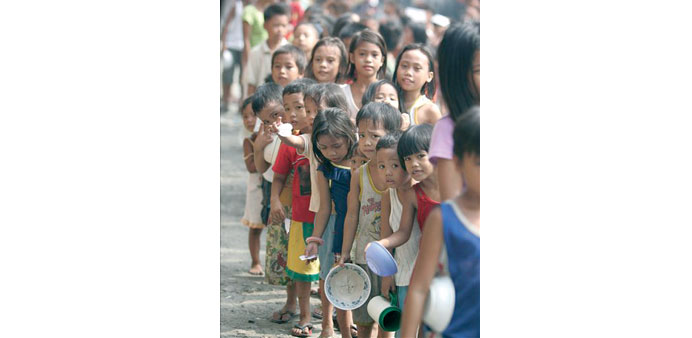
There seems to be a paradox in the present Philippine situation with a large number of Filipinos still mired in extreme poverty amidst an economic growth that is among the fastest in the region. |
On Tuesday, the National Statistical Co-ordination Board (NSCB), a government agency, announced that the poverty incidence in the Philippines stood at 27.9% in the first semester of 2012, practically unchanged from the same period in 2009, which was 28.6%, and in 2006 which was 28.8%.
The NSCB data show that 10% of the country’s population of about 97mn is still living below the poverty level.
In a briefing, NSCB secretary general Jose Ramon Albert said that during the first semester of 2012, a Filipino family of five needed 5,458 Philippine pesos ($136) monthly to meet basic food needs.
“Families earning that amount were considered to be living in extreme poverty,” Albert said.
After the bad news, that was bannered by leading Manila newspapers, came the good news on Wednesday when Moody’s Analytics described the Philippines as a “rising star” poised to record one of the fastest growth rates in the world.
Moody’s Analytics said that the Philippines is likely to grow between 6.5% and 7% this year and within the same range next year, “outperforming not only the anemic advanced economies but also many robustly growing emerging markets.”
It also said that if favourable economic trends continue, the growth rate for the Philippines could be close to 8% by 2016, Xinhua reported.
Earlier, the Asian Development Bank (ADB) and the World Bank also upped their growth forecast for the Philippines this year to 6%.
Moody’s Analytics, a sister company of credit rating watchdog Moody’s Investor Service, said the country’s 6.6% growth in 2012 was achieved despite weak growth in the US, a crisis in the eurozone and a slowdown in China.
On March 27, the Philippines also obtained its first-ever investment-grade rating from Fitch Ratings.
On a similar vein, international credit rating firm Standard & Poor’s has raised its growth forecast for the Philippines for this year from 5.9% to 6.5%.
At the same time, it said the economy was expected to post another robust growth of 6.3% in 2014.
“China and the Asean 5 - Indonesia, Malaysia, Philippines, Thailand and Vietnam - are more domestically driven and, therefore, continue to enjoy relatively high and stable growth rates. This is not the case elsewhere,” S&P said.
The paradox of continuing poverty amidst strong growth was explained by analyst Norio Usui, ADB senior country economist, who said the government must solve the problem of jobless growth if it hoped to reduce poverty.
“I am not surprised at all. The benefits of strong economic growth have not spilled over to the people because they still cannot find a job,” Usui was quoted as saying in a report. In January 2013 jobless rate stood at 7.1%, with a further 20.9% underemployed or those working fewer than 40 hours a week.
About 41.8% of the underemployed are in the farming sector.
Professor Benjamin Diokno of the University of the Philippines School of Economics said that the strong economic growth in 2010 and 2012 “were not enough to extricate a lot of people from the poverty trap.”
Senator Ralph Recto, chairman of the ways and means committee of the Philippine Senate, said that only the rich and the educated have benefited from the infrastructure projects of the government and not the poor and uneducated. “This led to income inequality with the rich getting richer and the poor poorer,” Recto said.