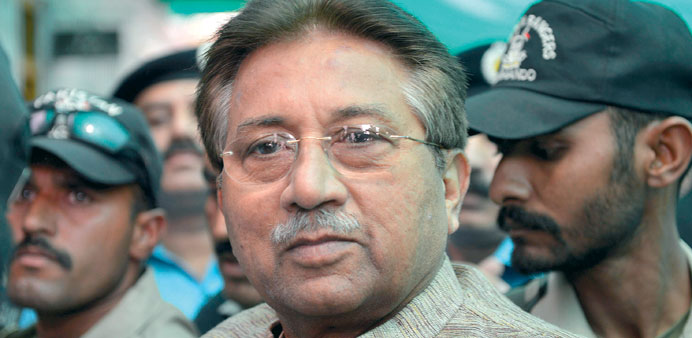
Facebooked? Pervez Musharraf, who stuck by his Facebook “standing” in a TV interview, arriving at the office of a judicial magistrate last week.
By Kamran Rehmat/Islamabad
A month after his return from more than four years of self-imposed exile, Pakistanis are still struggling to discern what convinced retired General Pervez Musharraf to jump headlong into a journey with a deadend.
Not only is he out of the election race following the rejection of his nomination papers but also facing a slew of cases that threaten to unravel his dream way beyond the ballot he was seeking although there has been a temporary relief with the caretaker government expressing its inability to push with a high treason case pertaining to the abrogation of constitution under Article 6 that carries the death penalty.
Admittedly, it is a trite difficult to keep a straight face but you have to wonder if this death wish was not borne out of a gross misreading of Facebook “likes” - nearing 900,000 at the time of writing this - to begin with. Musharraf appears to have been taken in by his swell account - the rite of passage being contingent on a mandatory “like” notwithstanding.
To be sure, Musharraf reinforced his Facebook “standing” in a TV show only last week, and when the anchor politely tried to reason with the former strongman on the fragility of such notions, he said: “I know you were going to bring this up, but why shouldn’t I talk about that (Facebook following as proof of people backing him).”
Those who know their Facebook fundamentals - it is hard to imagine in this user-friendly age of communication that one could be misled into such exaggerated notions of “likeability” - can only make light of such conclusions.
Most Facebookers, it can be presumed, would be interested in following the life and times of a figure as controversial as the ex-generalissimo. The mass figure betrays how Facebook followers can put up with the celebrity narcissism of a mandatory “like” to be able to glean statuses and updates of someone pitching his cyber tent fresh from a particularly crucial phase of history.
Musharraf remained in the spotlight for a considerable period post-Nine Eleven -a turning point in the US-led global war-on-terror that brought him an unexpected windfall.
But it is important to understand the great Facebook seduction in Musharraf’s case, which to begin with, is rooted in a self-fulfilling prophecy. After signing up with the US on the terror war, he sold and, in the end, came to believe his own-created perception that as well as being the bulwark against global terror, he had become indispensable for Pakistan.
At the peak of his powers and while hitting the post-exile lecture circuit, there never was any dearth of expatriate Pakistanis he came into contact with, who reinforced that perception on the basis of a poor view of politicians and democracy as practiced in Pakistan.
It is evident in the rather simplistic view that dominates the thinking of Pakistani diaspora. Politicians are rogues, democracy is not fit for a country like Pakistan, the people are suckers for the “danda” (a euphemism for authoritarian rule) - these were and still are some of the refrains that resonate with a significant majority.
One can argue with the obvious demerits inherent in such a sweeping sentiment but it sticks because inevitably, overseas Pakistanis are conflicted in terms of the contrast available to them in the countries they have migrated to.
The rule of law, its obedience and multifarious hues of meritocracy make Pakistani expatriates - whether in Gulf countries or in the West - make them impatient about the fare back home.
There may be flimsy knowledge but scant realisation that for half of her history, Pakistan has been ruled directly by the military, and save for one democratically-elected government of Zulfikar Ali Bhutto, every other civilian dispensation since had to look over its shoulders.
Even though Pakistan is poised for its first quintessential democratic transition -with power expected to change hands from one civilian government to another - it is, at best, a pyrrhic victory for democracy. The Pakistan People’s Party-led government was hemmed in by a hostile military, opposition, judiciary and the media.
To be sure, the ruling coalition did not cover itself in glory. The general perception is that it was perhaps the most inefficient, and on the face of circumstantial evidence, the most corrupt government in the country’s history.
Having said that, it is no small feat that they were able to forge consensus on significant constitutional reforms that considerably defanged the security establishment, and even though rival former prime minister Nawaz Sharif realised his mistake in backing the wrong horse initially, the PPP leadership successfully thwarted attempts to dislodge its government courtesy the Memogate - where Hussain Haqqani, the former ambassador to US was alleged to have secretively sought Obama administration’s intervention to save the PPP government from a possible coup.
Many observers think this is what a vast majority of overseas Pakistanis do not take a holistic view of. There is even lesser patience for staying the course to solidify the hard-earned democratic space.
All of this suits Musharraf although he conveniently, forgets that much of the intractable problems Pakistan finds itself in today are a direct legacy of his self-serving policies and that most of his compatriots have moved on even if Musharraf hasn’t - as the Facebook infatuation amply demonstrates.
Today, the electorate has a strong choice, if it wants to move away from so-called “status quo” forces. Imran Khan and his Pakistan Tehrik-e-Insaf have earned their spurs, rendering Musharraf passé.
If social media arithmetic was any guide, Khan has since long been the Pakistani with the highest number of followers on Twitter alone. But no-one suggests it is the basis of his popularity or support.
The widespread disdain for his exaggerated self-importance and sense of entitlement has come as a rude shock to Musharraf. One observer even suggested the other day that he take a sabbatical from his Facebook account since the “likes” have already caused him much to dislike.
** The writer is freelance journalist based in Islamabad. He can be reached at [email protected]