


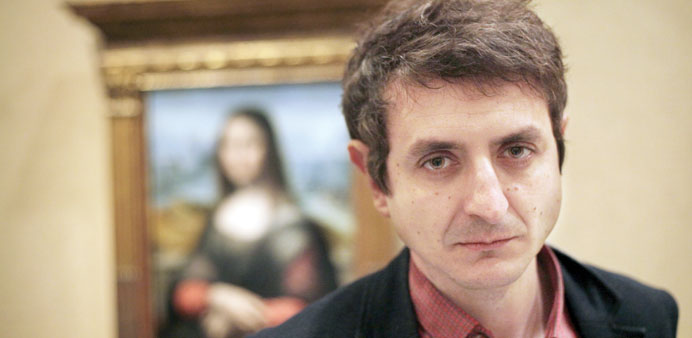
By Sara Barderas & Sinikka Tarvainen
For centuries, art experts have tried to penetrate the mystery of La Gioconda, or Mona Lisa — discussing endlessly whom the painting in the Louvre in Paris portrays and how it was created.
A second “Gioconda” discovered at Madrid’s Prado art museum is now shedding new light on Leonardo da Vinci’s 16th-century masterpiece.
The Madrid painting, which is believed to have been made by one of da Vinci’s pupils, caused a sensation in the art world when its discovery was made public in February 2012.
It was created simultaneously with da Vinci’s La Gioconda, with the pupil working alongside the master, Peio H Riano says.
The Spanish art historian and journalist has just published a book called La Otra Gioconda; El Reflejo de un Mito (The Other Gioconda; Reflection of a Myth).
“The work discovered at the Prado can solve part of the mystery” of La Gioconda, Riano said in an interview.
The model who posed for Leonardo and his pupil was Lisa Gherardini, wife of wealthy Florence textile merchant Francesco di Bartolomeo del Giacondo, according to Riano.
Many experts see da Vinci’s La Gioconda as a portrait of Gherardini.
Yet a comparison between the paintings created by Leonardo and his pupil reveals that the Gioconda at the Louvre is not the real Gherardini, but a personal artistic vision by Leonardo, Riano contends.
The “other Gioconda” is believed to have been in Spain since the 17th century.
The painting showing a figure of the Gioconda against a black backdrop was long thought to be just another replica of da Vinci’s masterpiece, which he painted between 1503 and 1506.
It had been hanging on the walls of the Prado on and off for years, without anyone paying special attention to it, until it began to be restored for an exhibition at the Louvre.
A thorough investigation — together with the intuition of restorer Ana Gonzalez Mozo — led to a breathtaking discovery. The black background had been added in the 18th century on top of a Tuscan landscape identical to that in da Vinci’s La Gioconda.
It is not known why the landscape was covered over with black. Some experts believe it had to do with the aesthetic tendencies at the time.
The wooden structure supporting the canvas turned out to be walnut — a Mediterranean wood — instead of black poplar, as had been believed. The classification of the structure as black poplar had misled experts, making them attribute the painting to a Dutch or Flemish artist.
Most important of all, the painter who created the portrait repeated da Vinci’s corrections, indicating that he worked alongside the master himself.
Experts have attributed the “other Gioconda” to Francesco Melzi or Andrea Salai. Some believe the painter was a Spaniard working with da Vinci.
“The Mona Lisa at the Prado is a new chapter in a novel that has not yet been finished and that is called Leonardo da Vinci. That novel has a very important chapter called Gioconda. And in this chapter, a secondary character suddenly appears, giving us a lot of information on the world’s most famous painting,” Riano says.
The portrait at the Prado shows a woman at least 10 years younger than in da Vinci’s painting. Unlike her equivalent at the Louvre, she has eyebrows. The painting at the Prado also reveals other details, such as the ornamented neckline of her dress and folds in her clothing.
When taking the commission to paint the wife of a merchant, da Vinci accepted a job from a commoner “whereas he usually only dedicated himself to the court or religious jobs,” Riano points out.
“Leonardo decided to pass the task on to a pupil at the workshop and to create another Gioconda himself at the same time,” the art historian says.
While da Vinci may have tasked the pupil with executing a faithful portrait, he himself gave his model a more mysterious appearance, endowing her with a disquieting smile. “The painting at the Prado proves that the portrait by Leonardo is not Lisa Gherardini, but an idealised and imaginary creation,” Riano says.
The differences between the two paintings are partly due to technique. The pupil painting alongside Leonardo did not use the master’s favoured technique of sfumato, which creates soft transitions between colours. The “other Gioconda” thus has clearer outlines.
Its splendid colours also contrast with the worse state of the painting at the Louvre, with its darkened and cracked surface. The comparison reveals that some of the details in the background can no longer be seen.
“What we see at the Louvre is a being in ruins, covered by dirt, submerged in green grime that contradicts Leonardo’s pictorial principles,” Riano complains.
The art historian does not spare in his words of praise for the restorers at the Prado, who carried out a “first-class” investigation in difficult economic conditions.
Spanish Prime Minister Mariano Rajoy’s austerity policies have slashed spending on culture. The state contribution to the budget of the Prado has been halved to €11mn ($14mn) in just three years. However, Spain’s flagship museum also has other sources of income, such as ticket and souvenir sales. — DPA