


By Ross Jackson/Staff Reporter
The ninth session of the US-Islamic World Forum, organised annually by the Ministry of Foreign Affairs in partnership with the Brookings Doha Centre, opened yesterday as part of a continuous effort to help bridge the divide between the United States and the Islamic world. This year the conference carries the theme “New voices, new directions” as a reflection of the major changes and new opportunities sweeping the Arab and Islamic world.

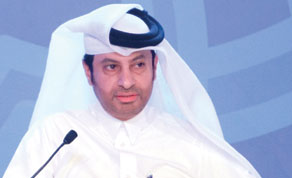
Sheikh Ahmed bin Mohammed bin Jabr al-Thani at the US-Islamic World Forum
Sheikh Ahmed bin Mohamed bin Jabr al-Thani, Minister’s Assistant for International Co-operation Affairs and Chairman of Permanent Committee for Organising Conferences, gave the keynote speech at the opening of the summit, where he addressed the realities of the Middle East’s ongoing political turmoil.
“With the past political and economic changes as a result of the Arab Spring uprising, some wonder what the effects will be, whether they will result in some Islamic regimes opposed to the US, and what will be the stance taken by the Western governments.” He said that it would be wise for Western governments to side with the Arab people, or they may soon find that have lost their allies, distorting the image of the West in the Arab world.
Sheikh Ahmed said that “we have to deal with the changes positively”, encourage countries seeking peaceful relations and “urge countries that still use violence against its citizens to cease using violence and grant their people the choice of freedom without humanitarian oppression. History will not have any mercy on such oppressive regimes. It is in the interest of such autocratic regimes to pursue successful democratic examples like Indonesia, and to benefit from such experiences.”
Sheikh Ahmed advised that, due to the nature of the changes in many Arab countries, the US and Western governments must in future have policies based on “comprehending the nature of such countries”, finding common ground, and building confidence in dialogue and mutual understanding instead of conflict.
Political leaders, religious leaders and political activists from over 50 countries have come together to produce new ideas and partnerships to try and tackle pressing issues in the East-West divide.
Conference organisers said that the conference will feature keynote speeches from world leaders on the challenges confronting communities around the globe, and the relations within the states. Yesterday’s plenary session looked at domestic political transformations, today’s session will address the challenges of social change and tomorrow’s session will talk about the implications of all these changes for international geopolitical forces. Panel discussions will address the role of arts and culture in social change, and the 2012 US presidential elections.
Organisers have built on past experience to assemble a new set of smaller working groups that bring together practitioners from specific fields to develop practical partnerships and policy recommendations out of three days of discussions. Individual groups will address democratic transitions, water security and the management of water resources, developing new mechanisms to promote the Muslim charitable sector, and a session for religious leaders on how compassion can be used for pluralism and tolerance locally and globally.
The first plenary session focused on domestic transformations in Tunisia and Egypt, with lessons from Indonesia’s democratic transition.
Hossam Bahgat, founder and director of the Egyptian Initiative for Personal Rights, lamented the commonly held belief held by supporters of the revolution that Egypt has in fact seen an electoral defeat, even though revolutionary candidates had more votes combined than the two frontrunners.
He said it is significant that the Muslim Brotherhood has lost 50% of its voting strength since the parliamentary elections, contributing to the polarisation of the country’s politics.
“As recently as November, many of us actually voted for the Muslim Brotherhood as part of the revolutionary bloc…After a few months as a parliamentary majority, that perception of the Brothers, as a force of the revolution, has changed significantly to the extent that now people are talking about the victory of the Brothers as a defeat of the revolution. With no judgment regarding who is right, the fact that this is the narrative now is very sad as it will contribute to further polarisation over the next few years.”
He said that there was a concern that the Brotherhood is trying to consolidate their power by limiting the “liberties won during the revolution” as they look towards a victory in the presidential election.”
His major concern was that “if we go ahead with the two candidates we have, the transition will probably not start for another four to eight years”.
Rached Ghannouchi, co-founder of Tunisia’s Ennahda Movement, said that the focus in his country should now be on finding jobs for the unemployed youth, who are in fact well-educated. He said that there needs to be a push for creating a link between education and work, where employment is based on merit. Eliminating corruption is a part of this effort, and must be a key objective of the government reducing inequality in opportunities.
He called on Gulf countries and the wider world to invest in Tunisia. “There is a boom in the field of tourism and a development in all fields,” said Ghannouchi. “Tunisia is going to grow quickly in the next few years, because dictatorship and corruption were obstacles that hindered investment and development.”