


|
Voters in Bhutan cast ballots to begin electing a new parliament yesterday for only the second time in the Himalayan nation’s history, five years after the monarchy ceded absolute power. |
The day was declared a public holiday in the landlocked Buddhist nation, wedged between India and China, while the land borders were closed for 24 hours over the election period.
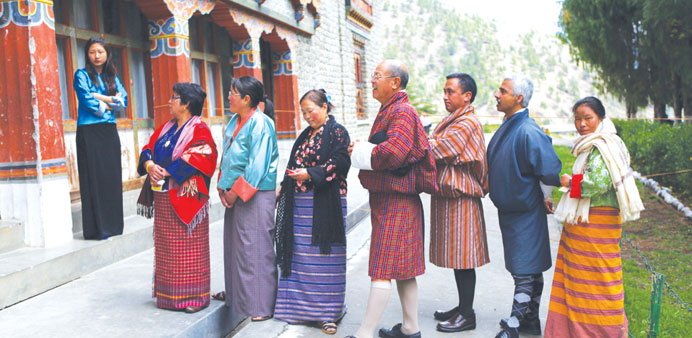
Voters lined up in their distinctive traditional dress — the knee-length wrap-around “gho” for men and the ankle-length dress known as the “kira” for women — at polling stations across the nation.
They used electronic voting machines to choose members of the upper house National Council, whose 25 members have no party
affiliation.
In coming weeks they will decide which of five parties will form the next government in the lower house
national assembly.
The role of the council is to monitor the actions of the government, review legislation and advise King Jigme Khesar Wangchuk. It can also propose laws, provided they are not financial.
Observers say the outcome of the council vote is unlikely to be a pointer to the national assembly elections, whose dates have still to be announced.
Bhutan is famed for its upscale tourism and unique yardstick of Gross National Happiness, which measures the mental well-being of citizens, not just their material wealth.
The nation has seen wide-scale development under the centre-right Druk Phuensum Tshogpa party of Prime Minister Jigmi Y Thinley, which scored a landslide win in 2008.
But a large income gap, youth unemployment and delinquency, and urban migration have caused
discontent among voters.
And while interest in the election process is reported to be high, confusion persists about parliament’s role in the deeply traditional nation where for decades the monarch’s word was law.
Bhutan held its first parliamentary elections in 2008 after its beloved royal family opted to step back and peacefully transform the country into a constitutional monarchy.