


|
|
Asian markets mostly climbed yesterday, with Tokyo surging as the dollar pushes back towards the ¥100 mark after the G20 cautiously endorsed the Bank of Japan’s huge stimulus measures.
Chinese shares dipped, however, as insurers suffered a sell-off after an earthquake struck Sichuan province, leaving more than 200 dead or missing and destroying villages.
Tokyo jumped 1.89%, or 251.89 points, to 13,568.37, while Seoul was up 1.03%, or 19.56 points, at 1,926.31.
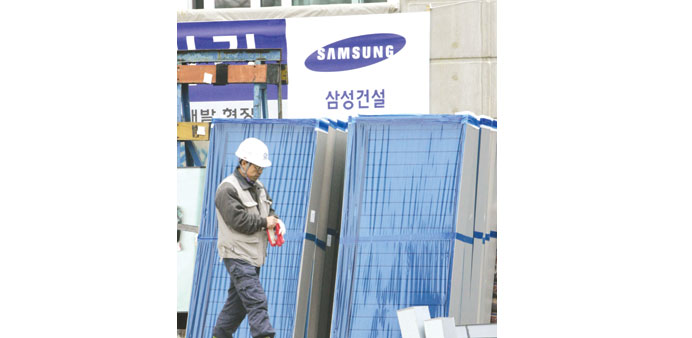
South Korean construction stocks have lost almost 20% of their value this month, falling to levels last seen four years ago, after huge losses at two firms sparked widespread fears of overseas projects going sour.
After the 2008 financial crisis, South Korean builders such as Samsung Engineering won a raft of foreign orders, particularly in the Middle East. Some of those contracts have turned into losers as fierce competition has driven down prices, and inexperience in new areas has meant extra costs.
Some builders’ earnings are likely to suffer as many large-scale but low-margin projects approach completion this year and next, analysts say.
Sydney rose 0.7%, or 34.7 points, to 4,966.6.
Hong Kong added 0.14%, or 30.80 points, to 22,044.37 but Shanghai was 0.11% lower, shedding 2.47 points to 2,242.17.
The yen added to gains made in New York on Friday after the Group of 20 economic powers agreed that Japan’s huge monetary easing measures unveiled this month were necessary to boost the country’s stagnant economy.
In a statement following their meeting in Washington, G20 finance chiefs said the policy actions “are intended to stop deflation and support domestic demand”.
Many countries, including the US, have expressed concern that Japan could be deliberately trying to force the yen lower to boost exports and cut imports via “competitive devaluation”.
But the G20, which includes the US and Japan, called for more efforts to stimulate “strong, sustainable and balanced” growth globally, and took note of Japan’s efforts towards that.
The dollar jumped in New York to ¥99.52 on Friday, from ¥98.23 the previous day.
In European trade Monday it stood at ¥99.80. The greenback is expected soon to break the ¥100 barrier, a level it has not seen since April 2009.
The euro fetched $1.3046 and ¥130.21, against $1.3057 and ¥129.94.
“The G20 effectively gave the green light for further yen weakness by supporting the aggressive easing by the Bank of Japan,” National Australia Bank said in a note.
“However, the G20 did add that it would like to see Japan also detail the structural reforms it can take to further boost growth.”
In Shanghai, insurance firms weighed on the market after Saturday’s quake, which flattened thousands of houses.
Ping An and China Life were among the losers, although construction companies were up slightly on speculation of short-term construction work.
Oil prices were higher. New York’s main contract, light sweet crude for delivery in May, added 62¢ to $88.63 a barrel in the afternoon and Brent North Sea crude for June delivery rose 30¢ to $99.95.
An ounce of gold fetched $1,432.35 at 1040 GMT, compared with $1,414.20 late Friday.
In other markets, Singapore rose 0.45%, or 14.87 points, to 3,308.92; Taipei added 0.5%, or 39.58 points, to 7,970.38; Wellington advanced 0.88%, or 39.16 points, to 4,438.66; Kuala Lumpur was flat, nudging up 0.40 points to 1,706.68; Bangkok rose 0.88%, or 13.64 points, to 1,559.10; Jakarta was flat, edging down 1.54 points to 4,996.92; and Manila surged 2.35%, or 163.38 points, to 7,120.48. The index broke 7,000 points for the first time. “You have a confluence of positives — strong earnings and excess liquidity — and what you have is a rampaging market,” Jose Vistan of AB Capital Securities told Dow Jones Newswires.