


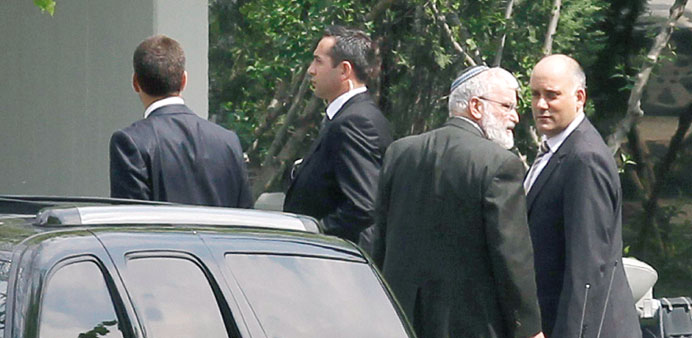
The Israeli delegation arrives at the Turkish foreign ministry in Ankara yesterday.
AFP/Ankara
Israeli and Turkish officials failed yesterday to agree compensation over a deadly 2010 Israeli raid on a Gaza-bound aid ship, but officials said they still hoped a crucial step would be taken towards restoring once-solid ties between the two countries.
“This problem will be solved at a second meeting, and if not enough, at a third one,” Deputy Prime Minister Bulent Arinc, who leads the Turkish team, told reporters after meeting the Israeli officials in Ankara.
“We both agree that this is a problem that needs to be swiftly resolved after a significant acceptance (on the part of the Israelis) on the need to lift the embargoes and blockade imposed on Gaza,” he added.
If resolved, a major stumbling block to upgrading bilateral diplomatic ties would be overcome, Arinc said.
He however acknowledged that neither the timetable nor the venue for a second get-together was yet clear.
Yesterday’s Monday meeting was the first stage of what Turkish officials have said would be a multi-step diplomatic process.
The Israeli embassy in Ankara refused to comment on the closed-door talks, which saw Israeli officials visit their formerly strategic ally for the first time in almost three years.
The high-stakes negotiations follow a formal apology Israel made last month for the botched raid on May 31, 2010 in which its commandos killed nine Turkish activists on a Gaza-bound flotilla.
US President Barack Obama had pressed Israel to make the gesture to mend relations between two of Washington’s key allies in the region.
Compensation and Ankara’s demand that Israel’s punishing restrictions on Gaza are the two sticking points in the talks, according to lawyers for the raid victims’ families.
Arinc warned the final word on whether a deal would work rested with the families of those killed.
“It’s a legal right for victims’ families to demand compensation,” said Arinc, adding that it would be up to them to accept a possible deal or go ahead with the court process.
“We, the government, will not take any action which will upset them,” he said.
But he urged the families to “trust the government” and avoid public statements which could lead to misunderstandings.
Israel imposed its blockade on Gaza in 2006 after Gaza militants seized an Israeli soldier, who was eventually freed in 2011 in a trade for 1,000 Palestinian prisoners held by Israel.
The blockade was strengthened in 2007, when the Islamist Hamas movement took control of Gaza, then eased somewhat following an international outcry over the killing of the Turkish activists.
Observers point to the fact that the prime ministers of both Turkey and Israel are directly involved in the process as a cause for optimism.
Ankara criticises Kerry call for PM to delay Gaza trip
Turkey expressed its dismay yesterday with the way US Secretary of State John Kerry asked Prime Minister Recep Tayyip Erdogan to delay a visit to the Gaza Strip planned for next month, saying that an experienced diplomat would not do so. Kerry’s statement “is not correct diplomatically”, Deputy Prime Minister Bulent Arinc told reporters. “It is up to our government to decide where our prime minister or a Turkish official will go and when.” The top US diplomat said on Sunday a possible trip by Erdogan to Gaza would be a “distraction” to US efforts to revive the Middle East peace process. Erdogan announced last week that he was planning to visit the Palestinian territory at the end of next month. “We are not in a situation to receive permission, or to accept in advance a go-ahead from anybody,” Arinc said. “The world and Mr Kerry know that Turkey is a country which can do whatever it wants to and when.” He stood firm on Erdogan’s plans to visit Gaza but said no timetable was set yet for such a trip.