


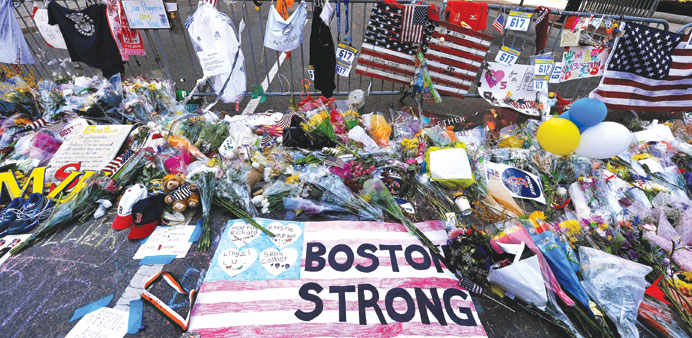
Items are placed by people visiting a makeshift memorial for victims near the site of the Boston Marathon bombings at the intersection of Boylston Street and Berkley Street two days after the second suspect was captured yesterday.
Reuters/Boston
The surviving suspect in the Boston Marathon bombings remained in serious condition in the hospital yesterday, unable to speak due to injuries to his neck and tongue sustained while on the run from police, officials said.
The US Federal Bureau of Investigation still was unable to interview Dzhokhar Tsarnaev, 19, Boston Police Commissioner Ed Davis told CBS television, and authorities may never be able to speak with him, Boston Mayor Thomas Menino said.
The suspect was in Beth Israel Deaconess Medical Center while US Attorney Carmen Ortiz, the federal prosecutor for the Boston area, was working on filing criminal charges, Davis said. An announcement on charges was expected later yesterday, he said.
Tsarnaev was shot in the throat and had tongue damage, said a source close to the investigation.
“We don’t know if we’ll ever be able to question the individual,” Menino told ABC’s This Week programme. He did not elaborate.
Tsarnaev will be defended by the Federal Public Defender Office, which had yet to issue any public statements on the case.
Investigators were seeking a motive for the Boston Marathon bombings and whether others were involved besides the ethnic Chechen brothers they suspect carried out the attacks.
The other identified suspect, older brother Tamerlan Tsarnaev, 26, was killed during a firefight with police on Friday, in the middle of the dramatic 26 hours between when the FBI released pictures of the two suspects and Dzhokhar Tsarnaev’s capture in the Boston suburbs.
Two bombs made in pressure cookers and packed with ball bearings and nails exploded at the Boston Marathon on Monday, killing three people and injuring 176 and setting of a tense week in the US that culminated in a massive manhunt on Friday with the greater Boston area on lockdown.
The two brothers may have been readying for a second attack at the time of the shootout, Davis told CBS. Early indications were the brothers acted alone, Davis and other officials said.
When police were able to move in after the hail of bullets stopped, they found unexploded devices littering the street and one in the carjacked SUV that the brothers had been driving. The devices contained the same type of shrapnel used in the marathon bombs.
“There is no doubt that they were made by these two guys,” Davis said.
Police finally found the suspect cowering in a boat in a backyard in Watertown, hours after police went door to door searching for him after he escaped on foot. A man went to check on his boat after the tarp had come loose.
“He saw the suspect, retreated, and called police and we were there instantaneously,” Davis said.
Tamerlan Tsarnaev traveled to Moscow in January 2012 and spent six months in the region, a law enforcement source said.
He spent at least a month last summer helping his father renovate his first-floor apartment next door to a dentistry in Makhachkala, a city in the Dagestan region on the Caspian Sea.
It was unclear if he could have had contact with militant Islamist groups in southern Russia’s restive Caucasus region.
A group leading an Islamist insurgency against Russia said yesterday it was not at war with the US, distancing itself from last week’s Boston bombing.
A statement from militants operating in Dagestan, where the brothers spent time as children, said the leading insurgency group Caucasus Emirate, led by Russia’s most wanted man Doku Umarov, was not attacking the US.
The role of the FBI is also being questioned after the agency said it had interviewed Tamerlan in 2011 after Russian security services raised concerns he followed radical Islam. The FBI said it did not find any “terrorism activity” at that time.
The bombings prompted contact between the US and Russia, and the Kremlin said on Saturday the presidents of both countries agreed by telephone to increase co-operation on counter-terrorism.