


|
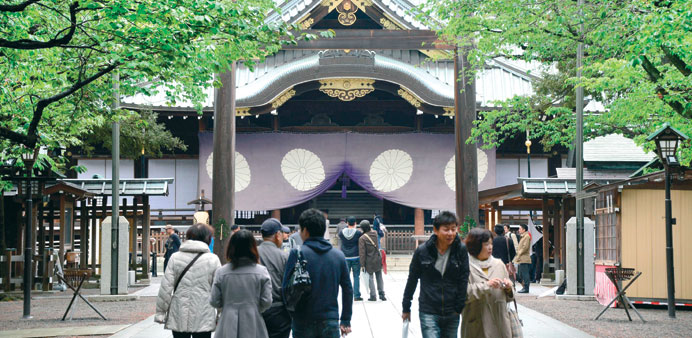
Japanese Prime Minister Shinzo Abe made a ritual offering of a pine tree to a shrine seen as a symbol of Japan’s former militarism yesterday, a gesture likely to upset Asian victims of Japan’s war-time aggression, including China and South Korea. |
Abe, an outspoken nationalist, offered the tree to the Yasukuni Shrine, where 14 Japanese leaders convicted as war criminals by an Allied tribunal are honoured along with other war dead. Abe did not visit the shrine.
Abe, who became prime minister for a second time after his Liberal Democratic Party’s (LDP) election win in December, is unlikely to visit the shrine as he seeks to rebuild relationships with China and South Korea.
Sino-Japanese relations deteriorated sharply in September after Japan bought islets in the East China Sea claimed by Beijing, sparking anti-Japanese protests across China.
Ties have been shadowed for years by what Beijing says has been Tokyo’s refusal to admit to wartime atrocities committed by Japanese soldiers in the country between 1931 and 1945.
Memories of brutal Japanese occupation also run deep in North and South Korea.
Two Japanese cabinet ministers visited Yasukuni yesterday.
Deputy Prime Minister Taro Aso, who is also finance minister, visited Yasukuni in the evening after returning from Washington, Jiji Press news agency reported.
Keiji Furuya, the chief of the National Public Safety Commission, visited the shrine tesrerdat morning at the start of its annual spring festival, one of his secretaries and a shrine official said.
“It is natural for me as a parliament member to extend my sincere condolences to the spirits of the war dead who had served their lives for this country,” Furuya said after his visit.
Abe did not make a pilgrimage but paid for equipment made of wood and fabric—which bears his name and title—which is used to decorate an altar, a shrine official said.
Liberal politicians tend to stay away but conservative lawmakers have routinely visited to pay respect to the war dead as well as to demonstrate their ideological stance.
Abe visited the shrine last year in his capacity as opposition leader before he took office as prime minister in December, leading to criticism from China’s state-run media.
During his first spell as premier in 2006-7 he stayed away from the shrine as he tried to mend ties with neighbouring nations strained because of former premier Junichiro Koizumi’s annual pilgrimage.