


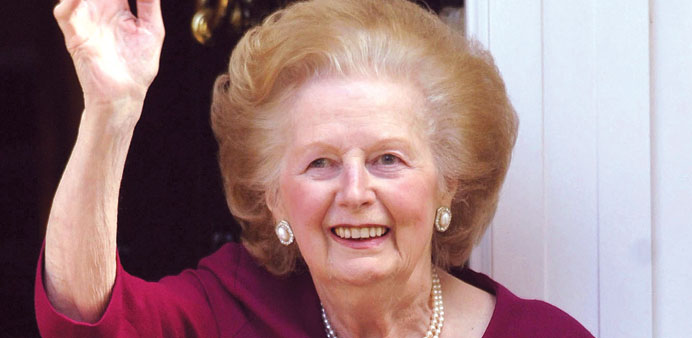
Guardian News and Media/London
Margaret Thatcher’s authorised biography was conceived 16 years ago with some crucial conditions: it was to be published after her death, she would never read it and, importantly, the people who contributed their thoughts and memories knew that. She would never know what they said.
Its writer, the then Daily Telegraph editor, Charles Moore, had full access to thousands of pages of Thatcher’s private and government papers, early access to documents held back under the 30-year rule and extensive interviews with the woman herself, in the years when she could talk and recollect more easily.
Not For Turning, the first of two volumes, will be published tomorrow.
“There’s a lot of excitement,” said Jon Howells of Waterstones. “People are expecting it to be pretty definitive.”
The 800-page book takes readers through her early years and government, ending at the October 1982 Downing Street dinner celebrating victory in the Falklands.
The way the book was produced is unprecedented.
Thatcher approached Moore in 1997 offering access to herself and her papers, and ruled that it should not be published in her lifetime. In 1998 it was bought for Penguin for a reported £750,000 by its then managing director, Andrew Rosenheim, and from then it has incubated, the first volume written and ready to be published once she died.
Stuart Proffitt, a publishing director at the Penguin imprint Allen Lane, says he and his team have not worked on anything else in the last eight days. It went to the printers on Wednesday night, just hours after her funeral, and will be available to buy tomorrow.
One big question, which cannot be answered until it has been read, is whether Moore, an ardent Thatcher supporter, was ever the right man to write objectively. Can someone so steeped in Tory politics be sufficiently detached?
Certainly Moore, known in Private Eye as Lord Snooty, is as archetypal as they come. In his Who’s Who entry he lists hunting as his sole recreation and once entertainingly wrote about the things he has never done: “I have never eaten a product of McDonald’s, drunk Coca-Cola, seen The Sound of Music, watched EastEnders or Coronation Street, worn a T-shirt (as an adult), or been to Disneyanything.
“I have never bought myself any equipment for playing music, or any musical record, CD or tape, never set a video, or attended a professional football, rugby or cricket match, never had a gin and tonic, sewn on a button, lain on a sunbed, carved a joint, or changed a wheel.”
After Eton and Cambridge, where his friends included Oliver Letwin and the Cond Nast president Nicholas Coleridge, Moore joined the Daily Telegraph aged 22 as political correspondent in the very year Thatcher came to power.
Within two years he was writing leaders and in 1984, still in his 20s, he became editor of the Spectator. Moore returned to newspapers in 1990 and edited the Sunday Telegraph between 1992 and 1995 and the Daily Telegraph for eight years until 2003, where he was highly regarded and well liked.
Can he be objective? Even Ken Clarke sounded mildly dubious when both men were on Question Time last week. The politician was commenting on how so many of the things being said on the Thatcher years were interpretive, at which point Moore interjected to say we would soon get “history”, in the form of his book.
“The editor of the Daily Telegraph says his biography is going to be history,” said Clarke. “We shall see.”