


|
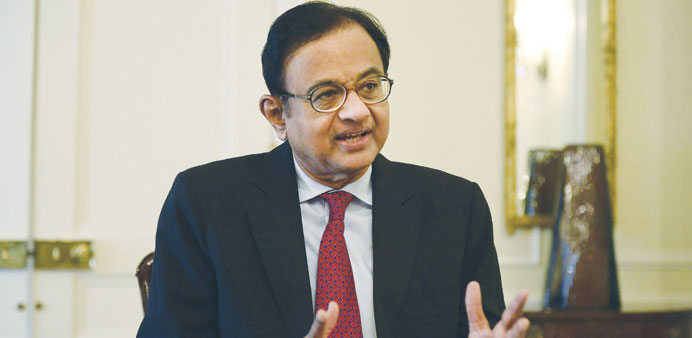
Indian Finance Minister P Chidambaram has said he expected his country’s current account deficit for the 2012-13 fiscal year that ended in March to be around 5% of gross domestic product and perhaps half that amount in one to two years. |
Chidambaram is in the US seeking foreign investment for India’s ailing economy, the third-largest in Asia, before making his way to Washington for the annual spring meetings of the International Monetary Fund and World Bank.
The Harvard-educated Chidambaram said he is close to unveiling a new initiative to remove bottlenecks in economic development projects and help convince investors India’s $1.8tn economy is back on a high-growth trajectory.
India is seeking foreign investment to fund its account deficit, which hit an all-time high of 6.7% of gross domestic product in the October-to-December period, driven by heavy imports of gold and oil and by muted exports.
“The third quarter (current account deficit) was large. The fourth quarter is likely to be better and for the overall year, probably around 5%, maybe a shade under 5%,” he told reporters before meeting with investors and business representatives.
Declining oil and gold prices likely helped cut the current account deficit in the fourth quarter ended March 31. A smaller deficit means less downward pressure on its currency, the rupee, which has stabilised between 54 and 55 per US dollar.
“Prudence dictates the current account deficit of any country should be roughly 2.5% or so. It is not an agreed number,” he said.
“If exports rise sharply, if the oil prices soften more quickly, the current account deficit could be contained at 2.5% even by next year,” he said, emphasizing there is no target date for bringing down this deficit.
Chidambaram returned as finance minister for a third time in August, and immediately launched a massive cost-cutting programme.
India’s gross domestic product growth hit a near four-year low of 4.5% in the quarter ended in December, an enviable performance when measured against the paltry growth in the developed markets.
In India’s case it represented a harsh drop in GDP growth. In the fiscal year ended March 31, GDP is expected to be 5% versus 6.2% in 2011 and 9.3% in 2010.
“There was a massive loss of confidence among domestic investors, and among corporate investors in the Indian policymaking framework,” said Jahangir Aziz, senior Asia economist at JPMorgan Chase & Co in Washington. “He squeezed spending as if there is no tomorrow in order to make sure the fiscal situation was brought under control,” he said.
The IMF forecast real GDP for India in FY2013 at 5.7%, 6.2% in FY2014. Its forecast for the current account deficit is 4.9% in 2013 and 4.6% in 2014.
Chidambaram said GDP estimates for fiscal 2013-14 are in a range of 6.1% to 6.7%.
“Beyond that, it is only an aspiration. In fiscal 2014-2015, we want to go above 7%. Fiscal 2015-2016, we want to go back to our potential growth rate, which is above 8%.”