


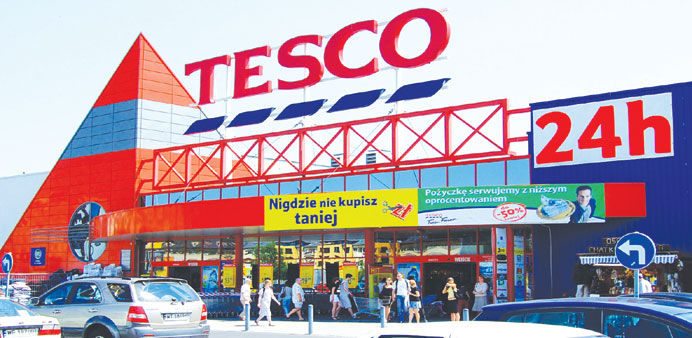
Tesco quits US and takes $3.5bn global writedown
Britain’s biggest retailer, Tesco, wrote down the value of its global operations by $3.5bn and announced plans to exit the US, as it tries to rebuild after a year when profit fell for the first time in two decades.
The group - the world’s third biggest retailer after Wal-Mart and Carrefour and one of Britain’s most consistent performers until a profit warning in January 2012 - said yesterday that abandoning its loss-making US venture Fresh & Easy would mean restructuring and other one-off costs of £1bn ($1.5bn).
Tesco also wrote down the value of its UK property by £804mn, reflecting a decision not to develop over 100 sites as more shoppers move to the Internet, and took a £495mn goodwill charge on its businesses in Poland, the Czech Republic and Turkey to account for a slowdown in demand.
Chief executive Philip Clarke declined to put the blame for the writedowns on his predecessor Terry Leahy, who took Tesco with great much fanfare into the US market in 2007 and also bought a huge amount of British development land.
Tesco reported an underlying pretax profit of £3.55bn for the 2012-13 year, broadly in line with analysts’ expectations but down 14.5% on 2011-12.
That reflected the £1bn cost of a UK turnaround plan, restrictions on store opening times in South Korea, Fresh & Easy losses and fallout from the eurozone debt crisis on eastern European markets - which Clarke said created “the worst set of economic circumstances for consumers since the end of communism”.
After taking account of the writedowns and a provision of £115mn to cover possible miss-selling of insurance products at Tesco Bank, the group’s statutory pretax profit slumped 51.5% to £1.96bn.
Fourth quarter sales at its British stores which have been open for more than a year grew 0.5%, excluding fuel duty and value-added tax. Although at the top end of analysts’ forecasts, this was less than growth of 1.8% recorded in the six weeks to January 5.
Yahoo
Yahoo Inc’s first quarter revenue fell short of Wall Street targets, as the Internet company continued to feel the effects of declining traffic to its Web properties and of falling display advertising sales, sending its shares down more than 4%.
Yahoo chief executive Marissa Mayer said the company’s plan to reverse the trend and restore the one-time Web powerhouse to its former glory was on track and would start showing results in the second half of the year. But she repeated previous comments that revitalising Yahoo will be a long-term project measured in years.
Yahoo also projected net revenue for the second quarter of $1.06bn to $1.09bn in a presentation posted on its website after its earnings release on Tuesday. That was below the average analyst expectation of $1.11bn in second quarter net revenue, according to Thomson Reuters I/B/E/S.
Yahoo said it earned $390mn, or 35¢ a share in the first three months of the year, compared to $286mn, or 23¢ in first quarter of 2012.
Yahoo’s overall net revenue, which excludes fees shared with partner websites, was $1.07bn in the first quarter, roughly flat from the year-ago period, according to Yahoo.
Yahoo’s net revenue was at the low-end of the $1.07bn to $1.1bn it forecast in January, in what was the first financial outlook that Yahoo offered since Mayer became CEO. Analysts polled by Thomson Reuters I/B/E/S on average expected net revenue of $1.1bn.
Intel
Intel Corp said its current-quarter revenue would decline as much as 8% and trimmed its 2013 capital spending plans, as personal computer sales drop due to the growing popularity of tablets and smartphones.
Despite persistently weak demand for PCs, Intel held firm on its previous forecast that 2013 revenue would grow by a low single-digit percentage, a target some analysts believe is becoming more difficult to hit.
Under pressure, Intel also said in its quarterly news release on Tuesday that it was reducing 2013 capital spending from $13bn to $12bn, plus or minus $500mn.
Intel said its first-quarter revenue fell to $12.58bn from $12.91bn in the year-ago quarter.
The world’s largest chipmaker forecast June-quarter revenue of $12.9bn, plus or minus $500mn. Compared to the second quarter of last year, that amounts to roughly no change or a drop of as much as 8%.
Analysts had expected $12.588bn in revenue for the first quarter and $12.854bn for the June quarter, according to Thomson Reuters I/B/E/S.
Intel posted first-quarter net income of $2.04bn, or 40¢ a share, down from $2.74bn, or 55¢ a share, in the year-ago period. Analysts on average had expected 41¢ per share.
Mattel
No 1 toymaker Mattel Inc reported stronger-than-expected first-quarter results, helped by cost controls and higher demand for American Girl and Monster High dolls, sending the company’s shares to their highest level in nearly 15 years.
The company, best known for its Barbie dolls and Hot Wheels cars, has raised prices globally and started making products for local consumption in countries including Brazil and India to hold the line on costs.
For the full year, however, the company forecast SG&A spending to be higher than last year. Expenses for the year include investments in new franchises, emerging markets and additional American Girl stores.
Net income rose to $38.5mn, or 11¢ a share, from $7.8mn, or 2¢ a share, a year earlier. Analysts on average were expecting a profit of 9¢ a share, according to Thomson Reuters I/B/E/S.
Mattel’s sales rose 7% to $995.6mn, beating the analysts’ average estimate of $986.5mn.
Abbott
Abbott Laboratories yesterday reported higher quarterly earnings after splitting off its branded drug business, and the company said demand was strong for its infant formulas and diagnostic products.
But first-quarter sales slumped for medical devices and generic prescription drugs, which together represent half of the company’s revenue.
Abbott reported a quarterly profit of $544mn, or 34¢ per share, from continuing operations, compared with $351mn, or 22¢ per share, a year earlier.
Excluding a tax benefit and other special items, the suburban Chicago company earned 42¢ per share. Analysts on average had expected 41¢ per share, according to Thomson Reuters I/B/E/S.
“This looks like a solid start to 2013,” said Stifel Nicolaus & Co analyst Rick Wise, who described results as “in-line” with expectations.
Sales rose 1.8% to $5.38bn, slightly below Wall Street expectations of $5.41bn.
BofA
Bank of America Corp posted a smaller-than-expected increase in quarterly profit yesterday as revenue in most of its businesses dropped, and the bank entered a new legal settlement linked to mortgage bonds.
The results underscore how Bank of America’s purchase of Countrywide Financial at the height of the housing crisis is still haunting the bank, and how even when the bank moves past its mortgage settlements, it faces a tough business environment.
Many of the bank’s revenue generators - including consumer banking, mortgages and debt, currency and commodities trading - turned in weaker performances in the first quarter. All told, adjusted revenue fell 8.4% to $23.85bn.
Net income quadrupled as expenses dropped and the bank set aside less money to cover bad loans. But Wall Street analysts were expecting an even bigger gain, and the comparison was flattered by a host of one-time items, including a year-earlier charge of $4.8bn related to the value of the bank’s debt.
The bank, the last of the big four US banks to report first-quarter results, said yesterday it expects quarterly savings on expenses of about $1.5bn by the fourth quarter of 2013, representing 75% of the quarterly target. In the first quarter, expenses fell 5.2% to $18.15bn.
Net income jumped to $2.62bn, or 20¢ a share, from $653mn, or 3¢, a year earlier.
Analysts on average had expected 22¢ a share, according to Thomson Reuters I/B/E/S.
The drop in the top line was a disappointment as well. Contributing to the overall revenue decline was a sharp drop in revenue from the fixed income, currency and commodities markets, down $829mn to $3.3bn.