


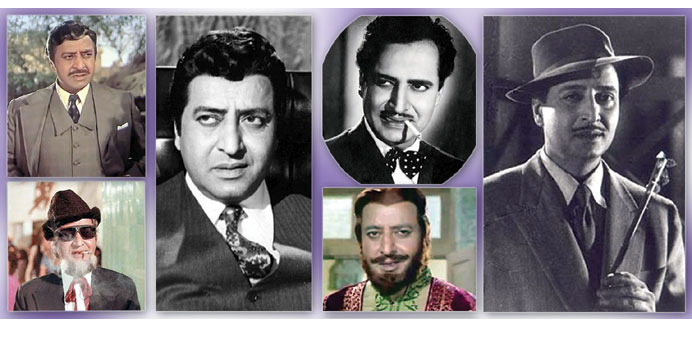
At 93, it was a little late in the day for Pran to
receive Indian cinema’s highest honour,
Dadasaheb Phalke Award. But it was well
deserved. By Gautaman Bhaskaran
|
|
It has never ceased to amaze me why villains in Indian cinema have been so dashing and debonair. Look at Nambiar, who acted with seven generations of South Indian stars beginning from the era of Balaiyah. He was so handsome that women swooned over him, leaving the great heroes cold!
Another commonality among many Indian screen villains is that they started their career as leading men, but soon graduated into bad men. Nambiar, who died in 2008 when he was 89, began his celluloid life as the good guy. As did many others.
The other villain — as illustrious and handsome as Nambiar and who has been in the news in recent months — is Pran. Now 93, he has been in and out of hospitals, and happily, the government woke up the other day to award him Indian cinema’s highest honour, Dadasaheb Phalke Award, named after the man who made the country’s first feature length movie in 1913, Raja Harishchandra.
The accolade ought to have gone to Pran a long time ago. But given the kind of politics that plagues the Indian film industry, it is a wonder that Pran got the award at all.
Extraordinarily handsome, Pran was spotted by writer Wali Mohamed Wali as the young man was whiling away his time outside a beetle leaf shop in Lahore. It is not surprising that Pran caught the eye of Wali, so good looking was the guy.
Born to a rich civil engineer and his wife in Delhi in 1920, Pran Krishan Sikand wanted to be a photographer. But Wali had other ideas for Pran. The writer, who was scripting the Punjabi movie, Yamla Jat, in 1940 thought that Pran would be the ideal hero for it.
Pairing with Noorjehan, Pran gave a boxoffice clinching performance, and the couple was immediately signed for the Hindi film, Khandan, where he again played a romantic hero.
Seven years later, India’s Partition in 1947 led to massive upheaval and displacement, and Pran’s family migrated to Indore in India, and later to Bombay, which soon replaced Lahore as the subcontinent’s centre for the cinema industry.
By the time India was divided into two countries (Pakistan being the other), Pran had done several movies. But his big break — which coincidentally was also Dev Anand’s — came in Bombay with Ziddi in 1948.
The film helped cinema discover Pran’s real strength, pushing him into villainous ways on the screen. And by 1950, he was Hindi cinema’s most sought-after bad man.
Not many today may remember all this, but Pran was just riveting as the terrible estate owner in the Bimal Roy-helmed, Ritwick Ghatak-penned spooky tale of reincarnation, Madhumati, pushing Vyjayanthimala’s character off a cliff to her death. Pran was as terrifying as the whip-wielding sadist in the story of twins, Ram Aur Shyam. In the 1960 Raj Kapoor’s social document on dacoits, Jish Desh Mein Ganga Behti Hai, Pran was the fire-breathing bandit, Raka, who killed the leader of his gang and tried to marry his daughter.
As the gambler in Munimji, as the murderous clown in Dus Lakh, Pran played to perfection. There were many, many other roles that he slipped into with the consummate ease of a man who seemed to have been born to act out villainy.
Off the screen, Pran was an epitome of gentlemanliness, courteous and cultured, and this contrast surprised many at a time when reels appeared to merge into the real.
Pran’s great versatility emerged after Kashmir Ki Kali (1964), where writers began to add a touch of grey to his characters. Here in this movie, Pran blended his cunning with humour which endeared him even more to his fans.
Manoj Kumar’s Upkar in 1967 saw Pran as a good man, though not for the first time — which was in Raj Kapoor’s Aah way back in 1953. Aah, however, went unnoticed. It took many more years after Upkar before Pran could finally brush off negativity. As the large-hearted Pathan, Sher Khan, in the Amitabh Bachchan starrer, Zanjeer (1973) Pran was just marvellous. This film also put him in the top earning bracket along with heroes like Rajesh Khanna.
But Pran is not remembered today for having played Sher Khan or even the witty villain in Kashmir Ki Kali. It is characters like Raka and the murderous estate owner that come to our mind when we think of Pran. And, of course his caustic lines like, “what is good about the morning”, said as a retort to his assistant’s greeting in Around the World.
Yet, an entire nation loved Pran. Perhaps loved to hate him!
Two stars at Cannes
At the 66th edition of the renowned Cannes Film Festival, two of India’s leading stars will walk the Red Carpet. They are Rajnikanth, whose unparalleled fan following can well be a subject for a serious thesis, and Amitabh Bachchan, often described as the one-man movie industry. Nothing can be more apt than their presence this year at the French Riviera. For Cannes will celebrate the centenary of Indian cinema with a country focus.
While Bachchan will be at Cannes as part of his first ever Hollywood film, Baz Luhrmann’s The Great Gatsby, which opens the Festival on May 15, Rajnikanth will be out there with the trailer of Kochadaiyaan, set to hit the screens within a few months.
Interestingly, while Cannes has not picked an Indian entry for the top competition slot in a long time, the Festival has been used as a launch pad for some desi movies. Shekhar Kapur announced his Paani a couple of years ago. Nobody knows when it will be made.
Madhur Bhandarkar took whom he thought would be his Heroine to Cannes to talk about his new venture. That the heroine herself had to be replaced soon after this PR exercise is another story. Mani Ratnam sent wife Suhasini to screen a teaser of his bilingual Raavan/Raavanan, which crashed at the box office.
Cannes has not been a lucky mascot for Indian cinema, no, not for a long long time. Not since Satyajit Ray’s Pather Panchali in 1956 or Adoor Gopalakrishnan’s Elippathayam (Rat Trap) in 1982. Ray’s work placed India on the world cinema map. Adoor’s work went on to become a classic, perhaps his finest work till now which made the master a favourite in Europe.
However, as the Festival sets about to publish its list of films on April 18, the question is how Indian will Cannes be this summer?
(Gautaman Bhaskaran has been writing on Indian and world
cinema for more than three decades, and may be e-mailed at [email protected])