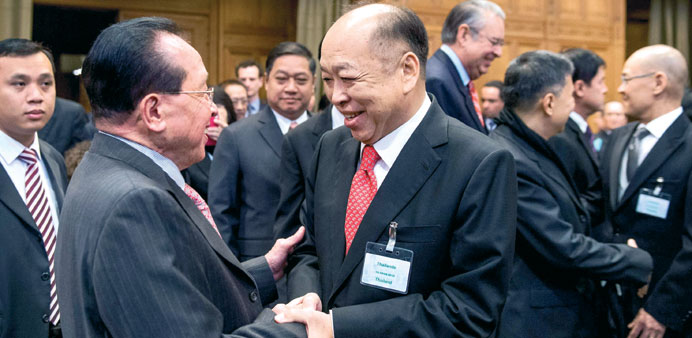
Thailand’s Deputy Prime Minister and Foreign Affairs minister Surapong Tovichakchaikul (right) shakes hands with his Cambodian counterpart Hor Namhong during a hearing at the UN’s highest court yesterday.
AFP/The Hague
Thailand and Cambodia took their dispute around a flashpoint ancient temple to the UN’s highest court yesterday, in a case Phnom Penh warned could end friendly relations between the countries.
The Hague-based International Court of Justice (ICJ) has begun a week of hearings after Cambodia asked two years ago for an interpretation of the 1962 ruling on the Preah Vihear temple.
Thailand does not dispute Cambodia’s ownership of the 900-year-old temple, a Unesco World Heritage site that has seen deadly clashes along their joint border. But both sides claim an adjacent 4.6-square-kilometre patch of land.
Without an interpretation of the 1962 ICJ ruling, there could be “unfortunate consequences which would prevent the two states from living in a friendly, peaceful and co-operative environment,” Cambodia’s Deputy Prime Minister and Foreign Minister Hor Namhong told the court. He stressed that the Preah Vihear temple was a “very important symbol of the peaceful relations between Thailand and Cambodia.”
Bangkok allegedly did everything “to delay a swift decision by the court,” he added.
Ahead of Cambodia’s opening statement yesterday, Hor Namhong told reporters his country “felt threatened” by troop incursions from Thailand.
A verdict from the ICJ, which judges disputes between states, is not expected for several months.
In February 2011, 10 people were killed in fighting at the Preah Vihear temple site and fresh clashes broke out farther west in April 2011, leaving 18 dead. The ICJ subsequently ruled that both countries should withdraw forces around the Khmer temple, which is perched on a clifftop in Cambodia but with access much easier from the Thai side.
Access from the Cambodian side was so difficult in the 1970s that it was the last place to fall to the Khmer Rouge regime, and also the Communists’ last holdout in the 1990s.
Cambodia and Thailand finally pulled hundreds of soldiers out of the disputed border area in July 2012, replacing them with police and security guards. The situation remains calm. But Cambodia said yesterday that despite a request to the Association of Southeast Asian Nations (Asean) last year, Indonesian observers have still not been put in place.
Thailand ahead of the hearings said it would “fight the case transparently and with our best effort.”
“When all the statements are released, people can consider the issues,” Thailand’s ambassador to The Hague, Virachai Plasai said ahead of the hearings.
Thailand says that arguments over the land bordering the temple stem from Cambodian efforts to define rights over it as part of its application for World Heritage status for the temple. The roots of the dispute are however much earlier, dating to maps drawn during French colonial disengagement in the early 20th century. Thailand is broadcasting the hearing live on its state-run television channel, with a translation in Thai.
Tensions between the two nations have calmed since mid-2011 when Yingluck Shinawatra, the sister of exiled former premier Thaksin Shinawatra, became Thai prime minister.