


By Staff Reporter/Pau, France
Total inaugurated the new high-performance computer of its Scientific and Technical Centre in Pau, France recently. This makes the group among the top 10 international companies in terms of computing power.
The event took place in the presence of Lionel Beffre, prefect of the Pyrénées-Atlantiques department, and Total president (Upstream) Yves-Louis Darricarrère.
This investment is intended to gain in time and in precision for modelling the subsurface and simulating the behaviour of reservoirs.
Speaking on the occasion, Darricarrère said: “We are proud of this leap forward in our performance which positions us in the vanguard of high technology at international level.
“This supercomputer, which is 15 times more powerful than its predecessor, has been specifically designed to meet the main technical challenges facing our industry.
Its intensive computing capacity constitutes a key competitive asset that is an integral part of the group’s bold exploration strategy.”
The supercomputer, which represents an investment of 60mn euros over four years, was commissioned on January 17 for the Seismic Imagery and Interpretation Department of Total’s Centre for Hydrocarbon Research.
It will be used as a tool to assist decision-making in the exploration of complex geological areas and to increase the efficiency of hydrocarbon production in compliance with the safety standards and with respect for the environment.
Designed by Silicon Graphics International, the Pangea supercomputer has a computing capacity of 2.3 petaflops.
A petaflop is equal to a million-billion operations per second. The computing capacity of Pangea is equivalent to that of 27,000 office computers altogether. Its unique computing architecture is based on over 110,000 calculation cores, seven-petabyte (7mn-gigabyte) storage capacity and an innovative cooling system whose circuit is integrated with the processors.
Requiring 2.8MW of electric power, the heat generated by this supercomputer is recovered, making it possible to heat the Scientific and Technical Centre.
The group plans to double the power of its computer by 2015.
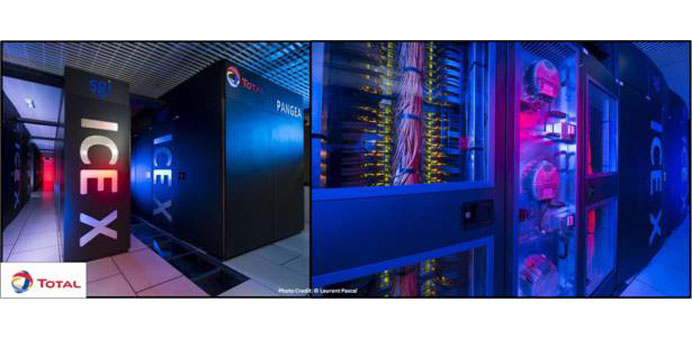
The Pangea supercomputer.