


DPA/AFP/Paris
The French government made public yesterday the personal assets of its ministers, revealing a more than 6mn-euro ($7.9mn) fortune belonging to Foreign Minister Laurent Fabius.
Internet surfers could go to the government’s website to find out about the bank accounts and properties owned by Prime Minister Jean-Marc Ayrault and his 37 ministers in what for France was an action that had never been seen before.
The move has sparked widespread debate in France, where personal finances are rarely discussed and – unlike in the United States where politicians often publish their tax returns – the wealth of public officials has long been considered a private matter.
Lawmakers on both the right and left have decried the move and the government expects a tough battle when it attempts to have the disclosure rule extended to parliamentarians in a bill to be introduced on April 24.
The revelations were made as part of President Francois Hollande’s reaction to a damaging tax scandal involving former budget minister Jerome Cahuzac. He was charged with tax fraud after lying about money he had stashed in a Swiss bank account.
Cahuzac stepped down after prosecutors said he would be investigated over the account and pledged to transfer the 600,000 euros ($770,000) held in it to his French account.
The admission undermined Hollande’s 2012 election promise of a “republic above reproach” and raised questions about his judgment as he battles an economic crisis.
Ayrault has promised a package of measures to ensure transparency about the assets of politicians.
Yesterday, the ministers disclosed bank accounts, securities, cash, properties, jewellery, art and cars.
Information on Ayault’s assets have long been known. He released them himself while he was campaigning, and they were also later released on the government’s website.
All ministers must declare their assets to an internal transparency commission, but this information had never before been made public.
The minister for the elderly, Michele Delaunay, disclosed yesterday family assets of 5.4mn euros ($7mn), recognising that her wealth would put her in an uncomfortable position.
“It is significant wealth. And it will be difficult to understand for the majority of the French, who are facing hard times,” she said in an interview with the daily Sud-Ouest.
Delaunay, the former head of a cancer clinic, said she and her husband had acquired their four homes and significant savings over lifetimes of work as well as through inheritance.
She said revealing their assets had been a “real challenge” but that she supported the disclosure measure.
“It is probably a necessary step toward a real battle against tax evasion and fraud,” she said. “If we had not taken it, in the context of Cahuzac, it may have been seen as a desire to protect certain people.”
Other ministers have also already come forward with their declarations.
Health and Social Affairs Minister Marisol Touraine said her declaration will show about 1.4mn euros in assets, based primarily on several properties in Paris.
Others have made more modest declarations, including Culture Minister Aurelie Filippetti, who said she owns a 70sq m (750sq foot) flat in Paris where she lives and, jokingly, a David Beckham T-shirt.
Industrial Renewal Minister Arnaud Montebourg declared owning a designer lounge chair worth about 4,000 euros, while Housing Minister Cecile Duflot, of the Greens, declared a 168,000-euro home and two cars, including a 14-year-old Renault Twingo vehicle.
Hollande himself will not be making a new declaration as he already released details of his wealth when elected president.
At the time he declared 1.17mn euros in assets, including a house in the southern town of Mougins and two apartments in Cannes, though he is still paying 1,500 euros a month on loans.
Hollande would also like to tighten regulations on lawmakers and leading bureaucrats and pass a law that would increase the punishments for tax evasion and corruption.
Daniel Lebegue, president in France of the non-governmental organisation Transparency International, welcomed yesterday’s revelations.
The fight against tax evasion has no end but “more has been done within one week than in the past 20 years”, he said.
With the economy stagnant, unemployment on the rise and the government slashing spending, senior officials have admitted that the move is risky and could create resentment by unmasking several millionaire ministers.
But the government has pushed ahead in the hopes the measure will help turn the page on a damaging scandal over Cahuzac.
The head of the main opposition right-wing UMP, Jean-Francois Cope, said yesterday that the measure would only “create tensions” in French society.
“The only consequence of all of this voyeurism will be that a certain number of people – businesspeople, artisans, professionals – will no longer want to engage in public life,” he told BFMTV.
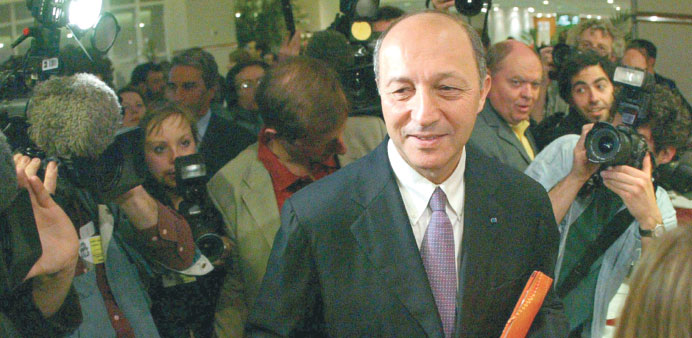
Fabius: has a fortune worth more than 6mn euros.