


|
|
Indian stocks rose on speculation softening inflation will prompt the central bank to cut interest rates for a third time this year.
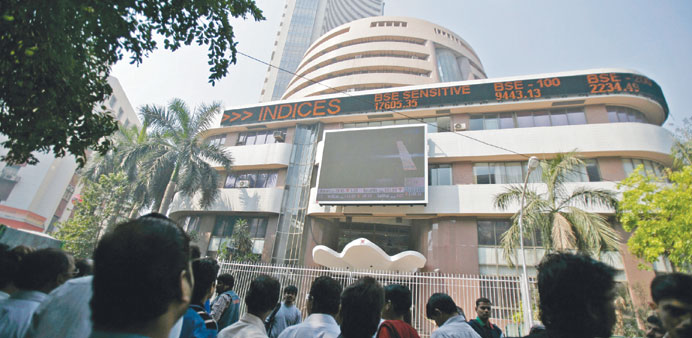
The S&P BSE Sensex climbed 0.6% to 18,357.80 at the close in Mumbai, with volumes 34% less than the 30-day average. State Bank of India jumped 3.1% and state-owned Oil & Natural Gas Corp increased the most in about two months, the best performer on the gauge. ITC, the nation’s largest tobacco manufacturer, advanced to a two-week high.
Gains in the wholesale prices slowed to 5.96% last month, the smallest gain in 40 months, government data showed yesterday. A decline in oil below $90 a barrel for the first time in more than a month and a plunge in gold prices to the lowest level since March 2011 may help give some respite to a country that ships in more than 80% of its oil needs and is the world’s biggest buyer of bullion, said A K Prabhakar, senior vice-president of Anand Rathi Financial Services in Mumbai.
“Falling commodity prices will cool inflation further, providing the central bank more room” to cut borrowing costs, Nilesh Karani, assistant vice-president of research at Magnum Equity Broking, said by phone yesterday. “The selloff in oil and gold bodes well for stocks.”
While the Reserve Bank of India cut funding costs in March for a second time this year, it has said lingering inflation curbs the scope for further cuts. The next review is on May 3.
State Bank advanced to Rs2,146.3, the highest close since March 19. ONGC jumped 3.3% to Rs319, the sharpest gain since February 19. Reliance Industries, owner of the world’s largest refining complex, advanced 2.4% to Rs793.6, the most in almost two months. ITC increased 2.4% to Rs299.95.
Bharti Airtel, the largest cell-phone company, gained 2.3% to Rs279.65. Infosys, India’s second- biggest software maker, climbed 1.9% to Rs2,339.05 after plunging 21% on April 12, the most in a decade.
Foreign funds bought a net $17.1mn of Indian shares on April 12. Funds were net sellers for six days through April 9, the longest stretch of withdrawals since May, on concern the slowest economic growth in a decade and the fastest inflation rate among major emerging nations will dent sales of goods from cars to cement.
The Sensex dropped the most in seven weeks on April 12, completing a second week of losses. The gauge has retreated 5.6% this year and trades at 12.3 times projected 12-month profits, compared with a multiple of 13.5 times at the start of 2013. The MSCI Emerging Markets Index trades at 10.2 times.
“The market is desperate for good news and the big fall in gold and oil helped sentiment,” Andrew Holland, chief executive officer of investment advisory at Ambit Capital in Mumbai, said by e-mail. The fall in commodity prices “will help bring down inflation but more significantly for markets, the pressure on current-account deficit would ease.”
The 50-stock CNX Nifty Index rose 0.7% to 5,568.40. Its April futures settled at 5,560. India VIX, which measures the cost of protection against losses in the Nifty, rose 1% to 16.61.
Meanwhile, India’s rupee fell to the lowest level in a week on concern slowing global growth will damp demand for the nation’s equities.
Official data yesterday showed China’s first-quarter gross domestic product rose 7.7%, less than the 8% median estimate in a Bloomberg News survey of 41 economists. Global funds sold a net $103mn shares in the first three days of last week, paring this year’s inflow to $10bn, exchange data show. The rupee pared losses after inflation eased in March by more than economists predicted.
“I am concerned about the impact of the Chinese data on Indian stocks and the hot-money inflows we have seen this year,” said Paresh Nayar, head of money markets and currency trading at FirstRand in Mumbai. “We have a domestic growth story that isn’t that great and now a slowdown in global growth will further pressure the rupee.”
The currency declined 0.2% to 54.6300 per dollar in Mumbai. It touched 54.8025 earlier, the weakest since April 8. One-month implied volatility, a gauge of expected moves in the exchange rate used to price options, rose 22 basis points, or 0.22 percentage point, to 7.75%.
Investors will be watching Indian trade data due this week to gauge the impact of falling global oil and gold prices on the country’s record current-account deficit, Nayar said. While easing crude costs will give “some respite” to a nation that ships in more than 80% of its oil needs, a fall in prices may spur demand in the world’s biggest bullion importer, he said.
Gold, which plunged into a bear market last week, dropped 0.2% yesterday while oil has fallen 3.3% in the past week. Wholesale price-based inflation in India slowed to a 40-month low of 5.96% last month, official data showed yesterday, compared with a 6.27% median estimate predicted in a Bloomberg survey.
Three-month onshore rupee forwards traded at 55.65 per dollar, compared with 55.59 on April 12.. Offshore non-deliverable contracts were at 55.51 versus 55.48.
Asian markets fall on weak China data, Korea fears
Asian markets slipped yesterday after a disappointing batch of Chinese growth figures, with traders keeping a wary eye on the Korean peninsula, where military tensions are high.
A pick-up in the yen dragged on Japan’s Nikkei after the US warned Tokyo to avoid competitive devaluation as the unit faces heavy selling pressure on the back of huge central bank stimulus measures.
Tokyo fell 1.55%, or 209.48 points, to 13,275.66, while Hong Kong shed 1.43%, or 316.38 points, to end at 21,772.67. Shanghai was down 1.13%, or 24.84 points, at 2,181.94.
Sydney finished 0.91%, or 45.6 points, lower at 4,967.9 and Seoul eased 0.2%, dipping 3.78 points to 1,920.45.
China said its economy grew 7.7% in the first quarter of the year, well below the 8% forecast in a poll of 12 economists by AFP.
The figure is also slower than the 7.9% in the previous three months and raises questions about the strength of the world’s number-two economy, which is a key driver of global growth.
In a statement the National Bureau of Statistics cited “the complicated and volatile economic environment at home and abroad”.
Yesterday’s data is the latest in a string of weak results, including on manufacturing, inflation and investment.
The economy grew 7.8% in 2012, its slowest rate in 13 years, and authorities have kept their growth target for 2013 at a conservative 7.5%.
Wendy Chen, a Shanghai-based economist at Nomura Securities, told AFP: “The (growth) figure was lower than market expectations, indicating the recovery in the real economy was not on a solid foundation and remained weak.”
She added that given concerns about inflation rising in the next few months it was unlikely the central bank will move to stimulate the economy by cutting interest rates “as loosening monetary policy may bring greater inflationary risks”.
Selling was also being fuelled by uncertainty over North Korea, with fears that Pyongyang could mark the anniversary of the birth of its late founder Kim Il-Sung yesterday by launching a missile.
On currency markets the yen extended gains seen in New York on Friday after the US said it was monitoring Japan’s policies and urged Tokyo to avoid “competitive devaluation” of its currency.
The comments from the US Treasury, in a twice-yearly report on foreign-exchange policies, come after the Bank of Japan earlier this month unveiled bold stimulus measures to kick-start the economy and defeat deflation.
The moves sent the dollar soaring to almost ¥100, a level not seen since April 2009.
In European trade the greenback fell to ¥98.03, from ¥98.37 in New York Friday and sharply down from ¥99.95 in Tokyo earlier Friday.
The euro sat at ¥128.05 from ¥128.89 and $1.3065, compared with $1.3099.
Oil prices fell, with New York’s main contract, light sweet crude for delivery in May dropping $2.69 to $88.60 a barrel, while Brent North Sea crude for May shed $2.27 to $100.84.
Gold was at $1,403.10 an ounce at 1025 GMT compared with $1,548.60 late on Friday.
In other markets, Singapore fell 0.3%, or 9.82 points, to 3,284.37; Taipei fell 0.74%, or 58.10 points, to 7,763.53; Manila fell 0.78%, or 53.66 points, to 6,837.77; Wellington rose 0.43%, or 18.94 points, to 4,454.71; Jakarta slipped 0.86%, or 42.62 points, to 4,894.59; Kuala Lumpur ended flat, dipping 0.76 points to 1,697.77; and Bangkok was closed for a public holiday.