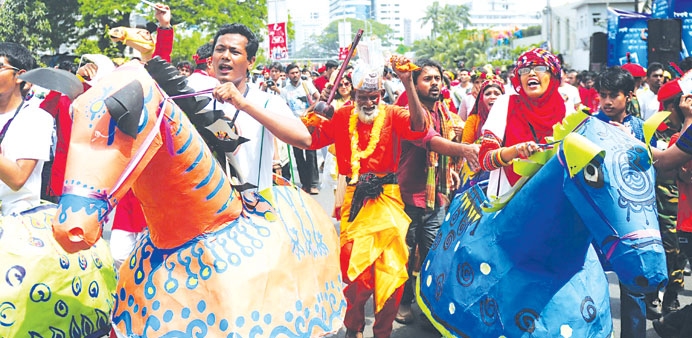
Bangladeshi revellers ride paper horses during a rally in celebration of the Bengali New Year or “Pahela Boishakh” in Dhaka yesterday.
Agencies/Dhaka
Prime Minister Sheikh Hasina has vowed to maintain secularism as Bangladesh’s state policy, amid countrywide celebrations yesterday to mark the Bengali New Year, seen by right-wing Islamists as “anti-Islamic” practice.
“Bangladesh will be a non-communal democratic country. Our country will be run in keeping with the spirit of the Madinah Charter of our beloved Prophet Muhammad” that charted out principles of religious harmony and co-existence, Hasina said in a statement on the eve of Pahela Baishakh.
Her remarks assume significance in the wake of recent large-scale protests by Islamist parties led by Jamaat-e-Islami demanding reinstatement of “absolute trust and faith in the Almighty Allah” in the constitution and capital punishment for those who would denigrate Islam and its prophet.
Meanwhile, thousands of people turned out on the streets and parks to celebrate Pahela Baishakh to welcome the
Bengali New year 1420.
Cultural and musical groups ushered in the first day of the new year with songs and other performances at city parks, besides a big ‘mongol shobhajatra’ procession by fine art students and youngsters in the capital.
Hundreds of security personnel in plain clothes enforced a sharp security vigil while anti-crime Rapid Action Battalion (RAB) and police were on alert, authorities said.
“This is a routine security measure but we are alert against any move by extreme right-wing Islamists or militant groups to ruin the celebration of the secular festival,” a police spokesman said.
But the tight security did not deter people’s enthusiasm as men in traditional wear and women in white and red saris joined children in the
celebrations.
The Pahela Baishakh celebrations witnessed a major setback in 2001 when Islamist militants carried out a bomb attack killing 10 people and injuring many others.
With nearly 99% population speaking in Bangla and giving the nation a repute of being a homogeneous one, the Pahela Baishakh celebrations started from Mughal Emperor Akbar’s reign.
According to the traditional practices particularly in rural Bangladesh, it is still customary to clear all dues on the last day of the Bengali month of Chaitra with businessmen opening “halkhata” or new book of accounts in their shops on Pahela Baishakh.
International / Bangladesh
Bangladesh’s prime minister vows to maintain secular character of country