


By Meredith Blake
|
|
If there’s one thing Gabriel Byrne has learned in recent years, it’s the importance of a comfortable chair.
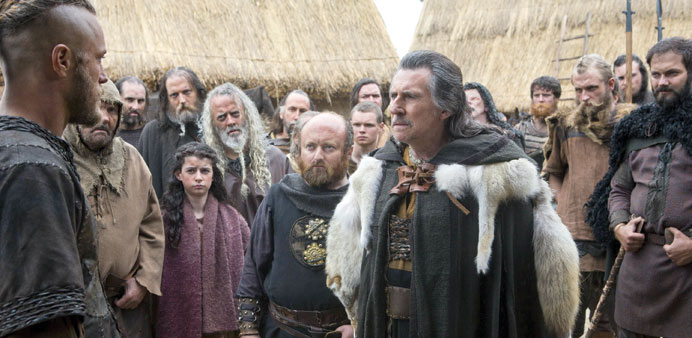
After a marathon 106 episodes as psychologist Paul Weston on the HBO drama In Treatment, Byrne stars in Vikings, History’s first full-length scripted series, as Earl Haraldson, a Norse chieftain with a flowing salt-and-pepper mane (all his own, thank you very much) and a taste for cruelty.
Despite the considerable differences between the shows — one set almost entirely in a shrink’s office in brownstone Brooklyn, the other in 8th century Scandinavia — they both left Byrne, well, uncomfortable.
“My biggest problem was always the chair. I would spend more time testing out the chair than anything else,” the actor says of his In Treatment experience. In Vikings, filmed in his native Ireland last summer, Byrne’s Haraldson can mostly be found perched in a regal throne, ordering his subjects on another plundering mission or condemning them to death via public beheading.
“Thinking that it wasn’t going to be anything like In Treatment, I looked at the throne and said, ‘Yeah, it’s a throne,’” he reports. Alas, he was wrong. The throne was too big, which may account for the sinister snarl Byrne wears on his face in so many of his scenes.
Make that “wore”: In an episode, Earl faced off in a death match with Ragnar Lothbrok, the visionary young upstart played by model-turned-actor Travis Fimmel. It didn’t turn out well for the ageing despot, who was dispatched to Valhalla with a blow from Ragnar’s axe and, finally, a merciful slit of the wrist.
While it was something of a shock that Vikings, which has garnered an impressive 5mn viewers a week and was recently renewed for a second season, killed off its biggest star so early in the series, for Byrne, 62, the finite commitment was a major selling point.
“I was kinda happy to die,” he confesses.
Byrne’s willingness to go gently into the good night certainly had something to do with the gruelling pace he maintained on In Treatment.
That project required Byrne to be on camera for virtually every dialogue-heavy scene over three seasons that ran as long as 43 episodes apiece. Even the world’s plushest armchair is going to start to feel oppressive at that point.
“In terms of pages shot per day and the volume of material, I think it was pretty spectacular. I don’t know that anybody else would have done that amount of sheer volume of words,” Byrne says, adding that although he is proud of In Treatment, he was “delighted” when it was cancelled in 2011.
The show’s fan base was less excited about the news. Though ratings were modest, Byrne was honoured with two Emmy nominations and a Golden Globe award, with his role as the troubled yet compassionate Weston burnishing his reputation as a sex symbol. “Being listened to and being heard is an experience that doesn’t happen terribly often,” he muses.
“To listen compassionately or nonjudgmentally to another person — not to get too heavy about it — but I once heard somebody say that was a form of real prayer.”
As for Vikings, an incentive to taking the role was the chance to finally collaborate with Vikings producer Morgan O’Sullivan, a friend since Byrne’s early days as an Irish soap star.
“He’s not an actor who just turns up; he’s a creator as well,” O’Sullivan says, citing Byrne’s work as a producer on the films Into the West and In the Name of the Father and his memoir, Pictures in My Head. “He’s one of the most erudite actors I know, and he’s an exceptionally good writer in his own right.”
Even a brief conversation with Byrne, who studied archaeology and Gaelic literature at University College Dublin, bears this out: He’s prone to articulate riffs about subjects such as the similarities between Viking raids and drone warfare or the current malaise in his native country.
But according to O’Sullivan, he’s also a guy “that you’ve got to convince,” and a limited time commitment was an essential part of the deal.
Vikings was also something of a homecoming for Byrne.
Though he was born and raised in Dublin, where his father was for a time a barrel maker at the Guinness factory, the New York-based actor hadn’t worked in Ireland since filming Into the West there in 1992. In a coincidence of timing, he followed Vikings with Quirke, a BBC series based on the novels of John Banville that also filmed in Dublin, a city that has transformed dramatically over the last two decades.
“Part of me felt like a ghost wandering through the edges of a world that I used to know. It’s a very strange experience, the return to somewhere that, to a great extent, exists only in your imagination,” he says with the casual lyricism seemingly only an Irishman can muster.
Byrne confesses that he was particularly nervous on his first day filming Vikings. The home crowd of several hundred extras could have had something to do with it, but then again, he always feels a little jittery at the start of a new project.
“No actor who’s any good can say truthfully to themselves, ‘Yeah, I’m good, I’ve got this sorted.’” —Los Angeles Times/MCT