


The Turquoise Mountain comes to the Museum of Islamic Art. By Fran Gillespie
|
|
Long ago, in Afghanistan, a fabulous city named Ferozkoh — the ‘Turquoise Mountain’ — was built by a military leader named Alauddin, who had conquered and overwhelmed the Gaznavid dynasty and destroyed their beautiful cities.
But Ferozkoh was destined soon to share their fate. Early in the 13th century, the Mongol hordes of Genghis Khan swept through the land, destroyed Ferozkoh and slaughtered every living thing. Ferozkoh disappeared from history, and its whereabouts are unknown to this day, although some archaeologists think it may be the city of Jam, 100 km east of Herat, with its famous 12th century brick minaret of the type that inspired Richard Serra’s iconic seven-sided sculpture in the park at Museum of Islamic Art (MIA).
Now the Turquoise Mountain has come to Doha, with the exhibition Ferozkoh: Tradition and Continuity in Afghan Art which opened on March 20 at the MIA. It showcases 37 objects from the MIA’s extensive collections, each piece alongside an example of superb craftsmanship by contemporary artisans and artists from Afghanistan.
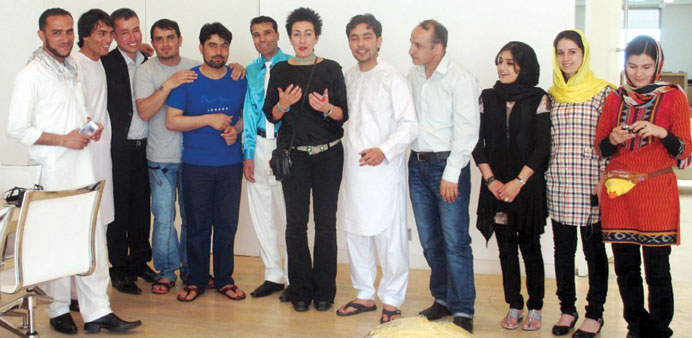
Last June, 16 students and their teachers from the Turquoise Mountain Institute for Afghan Arts and Architecture in Kabul, led by master woodworker Naser Mansori, were invited to Qatar from Kabul to examine pieces from the MIA’s collection and to use them as inspiration to create works of their own.
The exhibition was curated by Dr Leslee Michelson, a specialist in the arts of medieval Iran and central Asia. Former head of art education in the MIA, Deanne ‘DD’ Dewar, assisted the students both on their original visit and their return last month for the opening of the exhibition.
Many had never travelled abroad before, and had only seen such outstanding works of art in books or on a screen. The visit underlined the richness of cultural tradition in Afghanistan and the way in which, despite the years of turmoil in that war-torn country, the crafts for which it is celebrated are still being continued.
Before their visit to Doha, the students had nothing with which to compare and evaluate their work. “We did not know its historic value,” said one, “An exhibition like this is a great chance to show the world our rich culture. It’s enabled us to improve the quality of our work, and the examples we saw in the museum have encouraged us to be more creative.”
The Turquoise Mountain Institute was founded in 2006 at the request of Prince Charles, Prince of Wales, and President Karzai of Afghanistan. Its aim was to regenerate some of the historic areas of Kabul, including the district of Murad Khane in the city’s heart, which had been badly damaged by years of neglect during the conflict, and to promote the sustainable development of the nation’s craft industry.
Today Murad Khane is a vibrant cultural, educational and economic hub, a symbol of co-operation between Afghanistan and the international community.
In just a few years 65 historical buildings have been restored, a primary school has been set up for the children of the community and a health clinic has been established which treats over 1,000 patients a month.
As important as any of these achievements, the work of the Institute is helping to renew a sense of national pride among Afghani men and women. Some of the older teachers recalled the dark years of Taliban domination, when women were forbidden to study.
A master wood carver was banned from teaching because he had courageously continued to impart his skills to female students in defiance of the prohibition. Now almost as many women as men study at the Institute and are free to develop their talents.
Schools of woodwork, calligraphy, ceramics and jewellery provide tuition for over 200 students per year, and students are trained by some of the greatest living Afghan masters. Some of the teachers are elderly, well beyond the usual retirement age, but are dedicated to passing on their skills to those eager to learn.
In addition to practical classes, students receive training in a range of useful skills including business studies and the English language, and successful graduates are awarded a UK City and Guilds certificate, which is internationally recognised. Increasingly, graduates from Turquoise Mountain are undertaking commissions from hotels, embassies, museums, Unesco projects and private clients worldwide.
Back in Kabul, the students talked to Gulf Times about their wonderful opportunity to visit Doha and see their work showcased on an international stage. Maryam Saphir, aged 21, grew up as an Afghan refugee in Iran for the first 18 years of her life. She’s just graduated from the Institute after three years’ studying painting, and said, “I never thought I could be involved in such a project as Doha and I was so excited when I was selected. My parents were so proud of me! I really didn’t think an Afghan girl could do this, so I am very proud of myself too! I have learned so much from this project and I think it will act as a bridge to the future for me and for our work here at the Institute.”
Miniature painter Mohamed Tamim Sahibzada added, “Doha was an amazing experience for me. Seeing my work exhibited on such a big international stage has given me a huge amount of confidence in myself and a rush of new inspiration for my future work. I was particularly inspired to see the Timurid and Mughal pieces in the permanent collection demonstrating the talents of a bygone era of Afghan artisans. This is the first time I have seen such pieces. It is my desire to create new works of art which will inspire the next generation of Afghan artisans.”
Master jeweller Musawer Shah, who has been teaching at the Institute for the last six years, had this to say, “The exhibition gave me and my students the opportunity to show the international community the high skill levels achieved by Afghan jewellers. We had confidence that our pieces would be a success, and our young artisans have learned a lot through the process of preparing for the exhibition and discussing their work with the museum authorities. Indeed the feedback we had from the museum authorities was enormously encouraging for us, and will continue to spur us on to maintain our current standards of excellence, compete internationally, and inspire the next generation of Afghan artisans.”
The exhibition will remain open until June 22. Opening times for the Museum of Islamic Art are on the website www.mia.org.qa