


 |
|
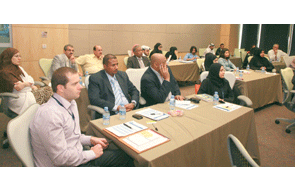
A section of the participants attending the seminar |
Staff Reporter
The Supreme Council of Health in collaboration with the Qatar National Food Safety Programme is planning to establish a national food safety agency.
It is envisaged that the agency will solely be responsible for regulating food safety, including plants and animal safety, in the country.
Presently, the food safety system in Qatar is being done by agencies in different government ministries including the Supreme Council of Health, Ministry of Environment and the Ministry of Municipalities Affairs and Urban Planning.
However, pending the establishment of the national agency, there are also plans to constitute a national risk assessment team, which would look into all issues concerning food safety.
“Under the Qatar National Food Safety Programme (QNFSP), which is the master planner of the regulatory agency and the development now was looking towards creating a new regulatory system for Qatar, which means a single agency and that has to be signed up as a policy issue by both the Cabinet and the QNFSP,” QNFSP senior regulatory affairs adviser Godwin Balasingam said yesterday.
He was speaking to mediapersons on the sidelines of a one-day seminar on ‘Food Risk Analysis’ organised by the SCH’s Food Safety and Environmental Health section.
The guest speaker at the seminar was New Zealand Ministry of Agriculture and Forestry’s Science, Information and Risk department director Dr Steve Hathway, who spoke at length on “Food Safety Risk Analysis: Policy and Practice”.
“The reason why we are clamouring for a single national agency for food control was that it is the international trend now and if there are too many agencies doing it and there is no proper collaboration between them, whenever there is a problem…that’s where the risk associated with food safety is going to occur,” Balasingam explained.
He mentioned that his organisation has initiated the process of establishing the agency and it is currently in the design phase.
“Right now, we are looking at the whole policies regarding food safety and there are a huge number of policies that impact on creating a regulatory agency. So, we are looking at creating a new law for Qatar on food safety as well as bio-safety and we are also looking at some institutional aspects that need to be created or be reformed in line with the policies and legislation, so all that is going on,” he said.
Balasingam explained that risk analysis was one of many institutional issues that may arise, while emphasising the need to have a number of systems in place such as the surveillance system, laboratory testing, inspection, certification, food recall and emergency response systems.
He said that the plan was to see Qatar become self-sufficient in terms of food production and the efforts were being made to reduce its food importation, which presently stands at 90% to about 40% in the next 10 years.
Speaking about the assessment team, SCH Food Safety and Environmental Health section manager Dr Wasan al-Baker said that a risk assessment team had been formed jointly by her section and the Communicable Diseases Control (CDC) section to serve as task-force until the national risk assessment team was formed.
“Creating a national assessment team is the vision for the future, but now we have created a risk assessment team in co-operation with the CDC section at the Supreme Council of Health and the overall ultimate goal was to have a single agency regulating food safety in the country,” she said.
The official explained that the team would look at all risks involved with food safety system, especially in terms of food contamination, and food analysis with the main objectives of conducting surveys.