


Reuters/Mumbai
Aslamkhan Bhikankha sold his wife’s jewellery and used all his savings to buy a flat in a Mumbai suburb which he now fears will soon be razed, leaving his family homeless.
The flat is in one of numerous illegal buildings in Mumbra that house poor migrant workers and face demolition by authorities over safety concerns after the collapse last week of a seven-storey block nearby in which 74 people died.
“If they break this building, they should run the bulldozer over us and kill us too,” said Bhikankha, a plumber who moved to Mumbai three years ago from a village 350km to the north in search of a livelihood.
“It will be better than losing all our money and living on the streets.”
The building collapse and Bhikankha’s plight underscore the government’s failure to develop policies to house the millions of people who flood from rural India into cities to do the low-wage jobs in a modernising economy, Asia’s third-biggest.
While building collapses are not uncommon in the country, many were shocked by the Mumbra disaster, one of the deadliest such incidents in recent years. The apartment block crumbled in seconds, instantly killing dozens of construction workers and their wives and children who had been living there.
A shortage of affordable housing in cities has led to rampant illegal construction by developers using cheap materials and shoddy methods in order to offer low-cost homes to low-paid workers, paying bribes to officials to turn a blind eye.
Despite several promises by the government to build affordable homes for the poor in densely populated cities, the country’s urban housing shortage is estimated at nearly 19mn households.
That lack of affordable housing is especially acute in Mumbai, the country’s financial capital and home to some of the world’s costliest real estate, where an estimated six out of every 10 people live in slums.
“This lack of quality affordable housing is why thousands choose to invest their hard-earned money in sub-standard construction,” said Brotin Banerjee, CEO of Tata Housing, which is part of salt-to-steel conglomerate Tata Sons and is building cheap homes in Boisar, on the outskirts of Mumbai.
Developers argue that expensive land, high interest rates, and corruption and red tape that cause delays make building low-cost homes financially unviable.
A report by property consultant Knight Frank shows house prices in Dadar, a middle-class area in central Mumbai, are Rs20,000-Rs30,000 per square foot, out of reach for people like Bhikankha, 28, who earns Rs7,000 a month.
He paid Rs605,000 for his sparsely decorated two-bedroom flat on the ground floor where he lives with his wife, two-year-old daughter and 12-year-old sister-in-law.
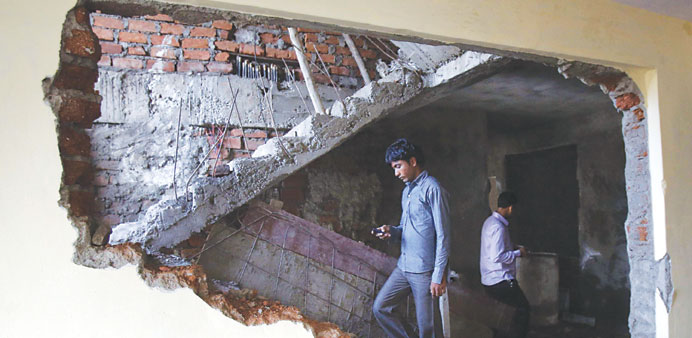
The top three floors of the eight-storey building have been reduced to rubble by local authorities who in the aftermath of the nearby collapse broke down the walls and ceilings of empty flats built without approval.
Electricity to the building has been cut and residents served evacuation notices.
Bhikankha said he has spent the last few days at home as he fears authorities will evict his family and demolish the building when he’s at work. As workers combed through the rubble of the collapsed apartment, another illegal and occupied building on the same site was being torn down. That six-storey structure crumbled like a sandcastle as an excavator clawed at the walls, reducing it in moments to a pile of mangled steel and concrete.
“The builders and government are playing with people’s lives,” said 32-year-old rickshaw driver Mohamed Khalid Sheikh, who lives nearby.
Thirteen people have been arrested and charged on various counts, including culpable homicide and bribery, in connection with the collapsed building that left 74 dead and 62 injured, a spokesman for the local authority said.
Bikankha, 28, walks up the staircase in an illegal building in which he lives in Thane district on the outskirts of Mumbai yesterday.