


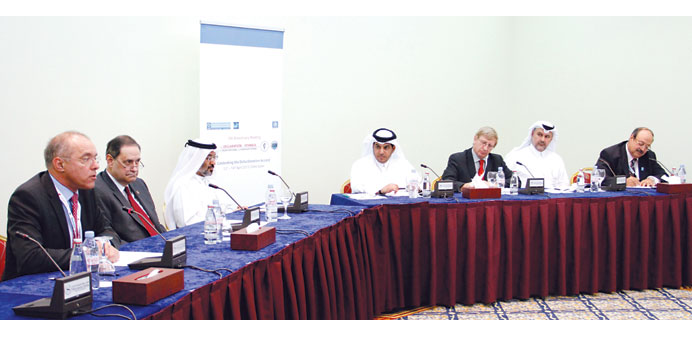
The Doha Donation Accord, launched in September 2010 to encourage organ donation, is now bearing fruits as up to 90% of Qataris in need of organs stay back in the country and also accept to be put on waiting list for organ transplantation, a senior health official said yesterday.
Addressing a press conference on the sidelines of a three-day international symposium on organ donation and transplantation, Dr Riadh Fadhil, director, Qatar Organ Donation Centre (Hiba) at HMC, said that since November last year to date, no Qataris have travelled abroad to source for an organ or do transplantation.
The symposium is also celebrating the Doha Donation Accord as well as the fifth anniversary of the Declaration of Istanbul on Organ Trafficking and Transplant Tourism.
There are presently some 47 patients on waiting list for kidney and 14 for liver transplant while some nine patients are hoping for the pancreas transplant programme to begin,
Dr Fadhil said.
Around 500 patients, who have suffered renal failure, are on dialysis.
Dr Fadhil said that up to 4,500 people have registered to donate organs, including some 2,500 signatures received within last year only due to HH Sheikha Moza bint Nasser’s signing as a donor.
“HH Sheikha Moza has set a very good example for the people. We are presently seeing a tremendous increase in the number of registered deceased donors as we now receive up to 120 consents per week,” he said.
The official said that up to 29 kidney and three liver transplants were done within the past two years. One kidney transplant is being done every month now compared to one in three-four months in the past.
Surgery Department chairman Dr Abdulla al-Ansari claimed that there has been a tremendous decline in the number of people on waiting list due to the dramatic increase in the number of organ donation.
“In the past we used to get one consent to donate organ per year and now we are receiving up to seven within three months and we are aiming for a higher number,” he said.
Hamad General Hospital’s medical director and Qatar Centre for Organ Transplantation director Dr Yousef al-Maslamani said that the plan to ensure that the Qatari identity card reflects that the holder has registered for organ donation, is on course.
“We have received the approval of the Ministry of Interior in this regard, but the process will take some time,” he said.
Among the 70 international experts in attendance at the symposium are the World Health Organisation (WHO) clinical procedures co-ordinator Dr Luc Noel, Declaration of Istanbul Custodian Group chairman Dr Jeremy Chapman, who is also the director of the Acute Interventional Medicine and Renal Services at Westmead Hospital; and Transplantation Society president Dr Francis L Delmonico.
Dr Chapman said that in 2011, WHO statistics showed that 24,000 liver transplants, 6,000 heart transplants, 4,000 lung transplants and 76,000 kidney transplants were done around the world.
“This seems much, but it is not enough … if you are on waiting list it feels like forever or for never and people get very desperate. Each community around the world has to work out how to best meet the needs to the community for transplantation and it is never easy to find solution,” he stated.
Dr Delmonico, who called for a global action to protect the vulnerable in organ donation and transplantation, said: “The Istanbul declaration came about five years ago to curb organ trafficking, commercialisation and organ tourism where the poor of the world are being victimised and exploited for their organs. The custodian group is also working to change practices all over the world.”
Dr Noel recalled that the WHO’s 40th Assembly had stated a resolution that trade for money in the human organ contravenes the declaration of human rights.
“The Istanbul declaration is the commitment of the major scientific and professional societies in the field to fight against exploitation through the trading in human organs. The State of Qatar is an example of commitment at the highest level for ethical donation and transplantation system,” he said, adding: “The country is playing a role in the sub-region and the country needs to collaborate with other GCC countries in that regard.”
Main points of Doha Donation Accord
The regulations of Doha Donation Accord were established in collaboration with the International Society for Organ Transplantation (ISOT) and it was as result of the close collaboration between the Supreme Council of Health, HMC and the Declaration of Istanbul Custodian Group.
The main contents of Doha Donation Accord are:
1) Giving organ donors and their families the Medal of Honour by the highest l authorities in State of Qatar.
2) Offering living donors (kidney or part of liver) the following privileges:
nMedical insurance throughout life
nA compensation for any health problems once they occur
nLife insurance
nA priority to get renal transplantation in case renal failure is developed in the future
nOther privileges offered by Qatar governmental and non governmental institutions for example offering a low price flight tickets by Qatar Airways.
nAll the organ donation expenses are covered including hospital expenses, transportation, residence, mobile phone communications
nAn economic compensation will be paid to the living donor for the loss of working days payment, spent during organ donation
3) Giving deceased donors (cadaver donors) the following privileges:
nFamilies of deceased donors will be honoured the Medals of Honour
nFamilies of deceased donors will be covered with social care according to their social state assessment
nThe body of deceased donor will be transferred freely to the original country.
nThe family of deceased donor will be offered a free flight ticket to accompany the body from Qatar to their original country.